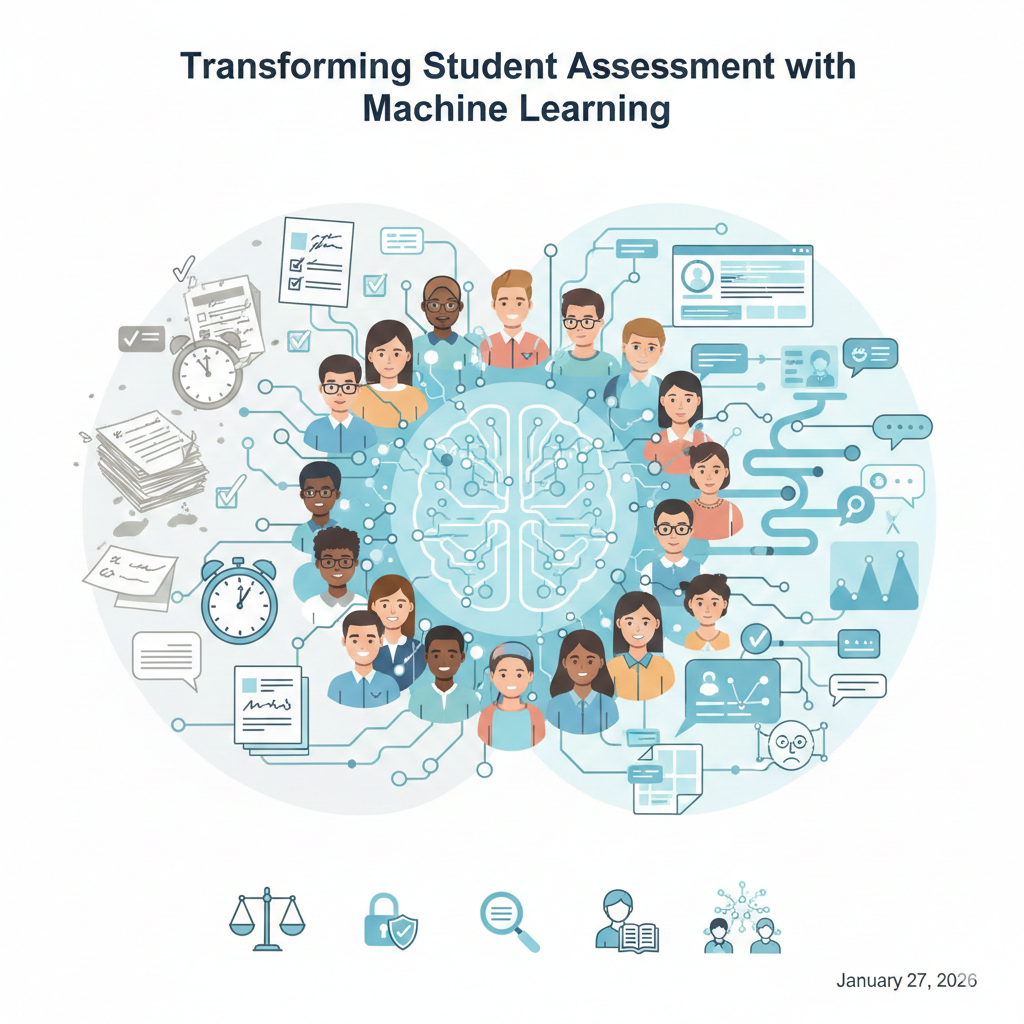
Abstract
The integration of Artificial Intelligence (AI) and Machine Learning (ML) is catalyzing a paradigm shift in the education sector, particularly in the domain of student assessment. Traditional evaluation methods, often characterized by their static nature, delayed feedback, and one-size-fits-all approach, are increasingly inadequate for the dynamic and personalized learning environments of the 21st century. This blog post argues for the transformative potential of ML algorithms in reshaping student assessment. We explore how ML is moving evaluation from a purely summative function to a continuous, formative, and adaptive process. Key applications are examined, including automated scoring of complex assignments, predictive analytics for early student intervention, personalized feedback systems, and the analysis of affective learning states. These innovations promise to enhance learning outcomes by providing timely, data-driven insights for both students and educators. However, the adoption of these powerful tools is not without significant challenges. This paper also addresses critical ethical considerations, such as algorithmic bias, data privacy, the need for transparency, and the potential for dehumanizing the educational experience. We conclude that while ML offers unprecedented opportunities to create more effective, efficient, and equitable assessment practices, its successful and responsible implementation hinges on the development of robust ethical frameworks, a commitment to fairness, and a focus on augmenting, rather than replacing, the essential human element of teaching.
1. Introduction
The landscape of modern education is undergoing a profound transformation, driven by rapid technological advancements and a growing emphasis on personalized learning (Rane, 2023). The global shift towards digital and hybrid learning models, accelerated by the COVID-19 pandemic, has further highlighted the need for innovative educational tools (Ara Shaikh, 2022). At the forefront of this evolution is Artificial Intelligence (AI), a field encompassing machine learning (ML), natural language processing, and algorithm production, which is fundamentally altering educational tools and practices (Akgun, 2022). AI-powered systems are being deployed across the educational ecosystem, from intelligent tutoring systems that adapt to individual learning paces to administrative tools that streamline institutional operations (Gligorea, 2023; Onesi-Ozigagun, 2024).
One of the most critical areas poised for disruption by AI is student assessment. For decades, educational assessment has been dominated by traditional methods such as standardized tests and manually graded assignments. While valuable, these methods often provide delayed, summative feedback that offers limited guidance for ongoing learning. They can be labor-intensive for educators and may fail to capture the full spectrum of a student's knowledge, skills, and cognitive development (Haudek, 2023).
Machine learning, a subset of AI that enables systems to learn from data and make predictions, offers a powerful alternative. ML algorithms can analyze vast and complex educational datasets to provide nuanced, real-time insights into student performance (Ersozlu, 2024). This capability facilitates a fundamental shift in the purpose of assessment, from a final judgment of learning (summative) to an integral part of the learning process itself (formative) (Fang, 2023). This blog argues that ML is not merely an incremental improvement but a transformative force in student assessment. We will explore the specific ways ML algorithms are being applied to evaluate student work, predict academic trajectories, and deliver personalized feedback. Furthermore, we will critically examine the significant ethical and practical challenges that must be navigated to ensure these technologies are used responsibly to foster equitable and effective learning environments for all students.
2. The Imperative for Change: Limitations of Traditional Assessment
The digital age has exposed the inherent limitations of conventional assessment methods. The reliance on manual grading is a significant bottleneck, consuming valuable educator time that could be better spent on direct instruction and student mentorship (Harry, 2023). This challenge is particularly acute in large-scale online courses and for complex, open-ended assignments like essays or scientific models, where providing timely, consistent, and high-quality feedback is a formidable task (Zhaı, 2022).
Moreover, traditional standardized tests, while useful for benchmarking, often promote a "one-size-fits-all" approach to education. Such assessments may not accurately reflect the diverse learning pathways and unique competencies of individual students, and the delayed nature of the feedback they provide limits their utility for guiding immediate instructional adjustments. The rise of generative AI tools like ChatGPT, Gemini and AI Tutors using Retrieval Augmented Generation (RAG) further complicates traditional assessment, creating new challenges related to academic integrity and the authenticity of student work (Hua, 2024; Ali, 2024). These limitations underscore the urgent need for more dynamic, responsive, and multifaceted assessment methodologies that can support the goals of modern pedagogy.
3. Machine Learning Applications in Student Assessment
Machine learning is revolutionizing student assessment through a variety of applications that offer greater efficiency, personalization, and deeper insight into the learning process. These applications leverage diverse ML algorithms, including decision trees, support vector machines (SVM), artificial neural networks (ANN), and natural language processing (NLP) models, to analyze educational data in novel ways (Alsariera, 2022).
3.1 Automated Scoring and Feedback
One of the most immediate impacts of ML is in the automation of grading and feedback (Hooda, 2022). While automated scoring for multiple-choice questions is well-established, recent advancements in NLP and deep learning have enabled the reliable assessment of more complex, open-ended responses. ML models can be trained on large datasets of human-scored examples to evaluate written essays, short answers, and even scientific arguments with a high degree of accuracy (Haudek, 2023). For instance, systems can assess student-drawn scientific models and their written descriptions, providing a multi-modal evaluation that aligns with next-generation science standards (Zhaı, 2022). Beyond simply assigning a score, these systems can provide immediate, targeted feedback, highlighting areas of strength and suggesting specific improvements (Ahmed, 2024). This automation releases educators from repetitive grading tasks, allowing them to focus on designing engaging learning experiences and providing personalized support to students (Bit, 2024).
3.2 Predictive Analytics for Early Intervention
ML excels at identifying patterns in data that can predict future outcomes. In education, predictive analytics models are used to forecast student performance, identify students at risk of falling behind, and predict withdrawal rates (Borna, 2024). These models analyze a wide range of input variables, including demographic data, past academic records, internal assessment scores, and digital footprints from virtual learning environments, such as the number of clicks on course materials (Hussain, 2018; Alhazmi, 2023). Studies have demonstrated the effectiveness of various algorithms, such as Random Forest, ANNs, and Extreme Learning Machines, in accurately predicting student success (Deo, 2020; Alsariera, 2022). The key benefit of this approach is its proactive nature; by identifying struggling students early, educators can provide timely and targeted interventions, thereby improving retention and overall academic outcomes (Rajeena, 2024).
3.3 Personalized and Adaptive Assessment
ML is the engine behind adaptive learning platforms, which tailor the educational experience to the individual needs of each learner (Gligorea, 2023). In the context of assessment, this means that the difficulty and content of questions can be adjusted in real-time based on a student's responses. If a student answers correctly, the system presents a more challenging question; if they struggle, it may offer a simpler problem or provide scaffolding. This dynamic approach, often called "stealth assessment," provides a more accurate and continuous measure of a student's evolving competency than a static test (Fang, 2023). By embedding assessment within learning activities, these systems reduce test anxiety and create a more seamless and engaging educational experience (Abisoye, 2024).
3.4 Assessing Affective and Behavioral Dimensions of Learning
Learning is not a purely cognitive process; it is deeply intertwined with emotions, motivation, and engagement. ML offers new ways to assess these affective dimensions as well. By analyzing multimodal data sources such as facial expressions captured via webcam, patterns of interaction with course materials, and sentiment in forum posts, ML models can generate insights into a student's emotional state and level of engagement (Vistorte, 2024). For example, a system might detect signs of frustration or boredom and alert the instructor or automatically suggest a different activity (Trabelsi, 2023). This holistic approach provides a richer, more complete picture of the learner, enabling educators to address not just academic needs but also the socio-emotional factors that influence success in a personalized manner in near real-time.
4. Challenges and Ethical Imperatives
The transformative potential of ML in assessment is accompanied by significant ethical and practical challenges that demand careful consideration. A primary concern is algorithmic bias. ML models learn from historical data, and if that data reflects existing societal biases related to race, gender, or socioeconomic status, the resulting assessment tools can perpetuate and even amplify these inequities (Akgun, 2022). Ensuring fairness, validity, and reliability in AI-powered assessments is therefore a critical challenge for developers and educators alike (Bulut, 2024). While no single approach fully resolves algorithmic bias, a growing ecosystem of data-centric, model-based, and governance-driven solutions has demonstrated measurable reductions in inequity when rigorously applied.
Data privacy is another major hurdle. These systems rely on the collection and analysis of vast quantities of sensitive student data, raising concerns about security, consent, and how this information will be used (Gligorea, 2023). The "black box" nature of many complex ML models also poses a problem of transparency and explainability. If educators and students cannot understand the reasoning behind an AI-generated score or recommendation, it undermines trust and accountability (Shum, 2019). The development of Explainable AI (XAI) techniques is crucial for making these systems more interpretable and trustworthy (Kar, 2023). Furthermore, understanding the governance of student data shared with online foundational models must be understood.
Finally, there is a risk of over-reliance on technology, which could lead to the dehumanization of education. While AI can provide valuable data, it cannot replace the empathy, intuition, and nuanced understanding of a human teacher. Research suggests that substituting human interaction with AI for support can have a net negative effect on student achievement and well-being, potentially increasing loneliness (Crawford, 2024). The goal must be to use ML as a tool to augment, not replace, the vital teacher-student relationship.
5. Conclusion and Future Directions
Machine learning is undeniably setting a new course for student assessment. It is shifting the paradigm from static, infrequent evaluations to a continuous, data-rich dialogue that is embedded within the learning process itself. The benefits are compelling: increased efficiency for educators, personalized and adaptive pathways for students, and the potential for early interventions that can significantly improve learning outcomes. Applications ranging from automated scoring of complex tasks to the assessment of students' emotional engagement are already demonstrating this potential.
However, the path forward requires caution and a deep commitment to ethical principles. The challenges of algorithmic bias, data privacy, and lack of transparency are not trivial; they are fundamental issues that must be addressed to build trust and ensure that these technologies promote equity rather than exacerbate existing disparities. Future research must focus on developing fairer, more transparent, and explainable AI models. Concurrently, educational institutions and policymakers must collaborate to establish clear ethical guidelines and robust data governance policies for the use of AI in assessment (Shum, 2019).
Ultimately, the success of ML in transforming student assessment will depend on our ability to integrate these powerful tools into a human-centered pedagogical framework. This requires investing in professional development to equip educators with the skills to use these systems effectively and interpret their outputs critically (Akgun, 2022). If navigated with wisdom and foresight, the integration of machine learning into educational assessment holds the promise of creating more responsive, effective, and equitable learning environments for generations of students to come.
References
Abisoye, A (2024). Creating a Conceptual Framework for AI-Powered STEM Education Analytics to Enhance Student Learning Outcomes. Journal of Frontiers in Multidisciplinary Research, 5(1), 157-167. https://doi.org/10.54660/.ijfmr.2024.5.1.157-167
Ahmed, S, Zaki, A, & Bentley, Y (2024). AI and Personalised Grading Criteria. Advances in educational technologies and instructional design book series, , 85-113. https://doi.org/10.4018/979-8-3693-2145-4.ch004
Akgun, S, & Greenhow, C (2022). Artificial intelligence in education: Addressing ethical challenges in K-12 settings. AI and ethics, 2(3), 431-440. https://doi.org/10.1007/s43681-021-00096-7
Alhazmi, E, & Sheneamer, A (2023). Early Predicting of Students Performance in Higher Education. IEEE Access, 11, 27579-27589. https://doi.org/10.1109/access.2023.3250702
Ali, K, Barhom, N, Tamimi, F, & Duggal, M (2024). ChatGPT-A double-edged sword for healthcare education? Implications for assessments of dental students. European journal of dental education : official journal of the Association for Dental Education in Europe, 28(1), 206-211. https://doi.org/10.1111/eje.12937
Alsariera, YA, Baashar, Y, Alkawsi, G, Mustafa, A, Alkahtani, AA, & Ali, N (2022). Assessment and Evaluation of Different Machine Learning Algorithms for Predicting Student Performance. Computational intelligence and neuroscience, 2022, 4151487. https://doi.org/10.1155/2022/4151487
Ara Shaikh, A, Kumar, A, Jani, K, Mitra, S, García-Tadeo, DA, & Devarajan, A (2022). The Role of Machine Learning and Artificial Intelligence for making a Digital Classroom and its sustainable Impact on Education during Covid-19. Materials today. Proceedings, 56, 3211-3215. https://doi.org/10.1016/j.matpr.2021.09.368
Bit, D, Biswas, S, & Nag, M (2024). The Impact of Artificial Intelligence in Educational System. International Journal of Scientific Research in Science and Technology, 11(4), 419-427. https://doi.org/10.32628/ijsrst2411424
Borna, M, Saadat, H, Hojjati, A, & Akbari, E (2024). Analyzing click data with AI: implications for student performance prediction and learning assessment. Frontiers in Education, 9. https://doi.org/10.3389/feduc.2024.1421479
Bulut, O, & Beiting-Parrish, M (2024). The Rise of Artificial Intelligence in Educational Measurement: Opportunities and Ethical Challenges. Chinese/English Journal of Educational Measurement and Evaluation, 5(3). https://doi.org/10.59863/miql7785
Crawford, J, Allen, K, Pani, B, & Cowling, M (2024). When artificial intelligence substitutes humans in higher education: the cost of loneliness, student success, and retention. Studies in Higher Education, 49(5), 883-897. https://doi.org/10.1080/03075079.2024.2326956
Deo, R, Yaseen, Z, Al‐Ansari, N, Nguyen‐Huy, T, Langlands, T, & Galligan, L (2020). Modern Artificial Intelligence Model Development for Undergraduate Student Performance Prediction: An Investigation on Engineering Mathematics Courses. IEEE Access, 8, 136697-136724. https://doi.org/10.1109/access.2020.3010938
Ersozlu, Z, Taheri, S, & Koch, I (2024). A review of machine learning methods used for educational data. Education and Information Technologies, 29(16), 22125-22145. https://doi.org/10.1007/s10639-024-12704-0
Fang, Y, Roscoe, R, & McNamara, D (2023). Artificial intelligence-based assessment in education. Edward Elgar Publishing eBooks, , 485-504. https://doi.org/10.4337/9781800375413.00033
Gligorea, I, Cioca, M, Oancea, R, Gorski, A, Gorski, H, & Tudorache, P (2023). Adaptive Learning Using Artificial Intelligence in e-Learning: A Literature Review. Education Sciences, 13(12), 1216-1216. https://doi.org/10.3390/educsci13121216
Harry, A, & Sayudin, S (2023). Role of AI in Education. Interdiciplinary Journal and Humanity, 2(3), 260-268. https://doi.org/10.58631/injurity.v2i3.52
Haudek, K, & Zhaı, X (2023). Examining the Effect of Assessment Construct Characteristics on Machine Learning Scoring of Scientific Argumentation. International Journal of Artificial Intelligence in Education, 34(4), 1482-1509. https://doi.org/10.1007/s40593-023-00385-8
Hooda, M, Rana, C, Dahiya, O, Rizwan, A, & Hossain, M (2022). Artificial Intelligence for Assessment and Feedback to Enhance Student Success in Higher Education. Mathematical Problems in Engineering, 2022, 1-19. https://doi.org/10.1155/2022/5215722
Hua, H, & Yao, CJ (2024). Investigating generative AI models and detection techniques: impacts of tokenization and dataset size on identification of AI-generated text. Frontiers in artificial intelligence, 7, 1469197. https://doi.org/10.3389/frai.2024.1469197
Hussain, M, Zhu, W, Zhang, W, & Abidi, SMR (2018). Student Engagement Predictions in an e-Learning System and Their Impact on Student Course Assessment Scores. Computational intelligence and neuroscience, 2018, 6347186. https://doi.org/10.1155/2018/6347186
Kar, S, Das, A, Chatterjee, R, & Mandal, J (2023). Assessment of learning parameters for students' adaptability in online education using machine learning and explainable AI. Education and Information Technologies, 29(6), 7553-7568. https://doi.org/10.1007/s10639-023-12111-x
Onesi-Ozigagun, O, Ololade, Y, Eyo-Udo, N, & Ogundipe, D (2024). REVOLUTIONIZING EDUCATION THROUGH AI: A COMPREHENSIVE REVIEW OF ENHANCING LEARNING EXPERIENCES. International Journal of Applied Research in Social Sciences, 6(4), 589-607. https://doi.org/10.51594/ijarss.v6i4.1011
Rajeena, M, & Quraishi, A (2024). Leveraging Artificial Intelligence for Student Performance Monitoring. International Journal of Research Publication and Reviews, 5(5), 9642-9645. https://doi.org/10.55248/gengpi.5.0524.1364
Rane, N, Choudhary, S, & Rane, J (2023). Education 4.0 and 5.0: Integrating Artificial Intelligence (AI) for Personalized and Adaptive Learning. SSRN Electronic Journal, . https://doi.org/10.2139/ssrn.4638365
Shum, S, & Luckin, R (2019). Learning analytics and AI: Politics, pedagogy and practices. British Journal of Educational Technology, 50(6), 2785-2793. https://doi.org/10.1111/bjet.12880
Trabelsi, Z, Alnajjar, F, Parambil, M, Gochoo, M, & Ali, L (2023). Real-Time Attention Monitoring System for Classroom: A Deep Learning Approach for Student’s Behavior Recognition. Big Data and Cognitive Computing, 7(1), 48-48. https://doi.org/10.3390/bdcc7010048
Vistorte, AOR, Deroncele-Acosta, A, Ayala, JLM, Barrasa, A, López-Granero, C, & Martí-González, M (2024). Integrating artificial intelligence to assess emotions in learning environments: a systematic literature review. Frontiers in psychology, 15, 1387089. https://doi.org/10.3389/fpsyg.2024.1387089
Zhaı, X, He, P, & Krajcik, J (2022). Applying machine learning to automatically assess scientific models. Journal of Research in Science Teaching, 59(10), 1765-1794. https://doi.org/10.1002/tea.21773