AI IN EDUCATION · Institute for Future Intelligence
Smarter Decisions using SMART-AI
Why the SMART-AI framework is the missing piece in how we develop and deploy AI in classrooms, labs, and the workplace.
Dylan A. Bulseco, Ph.D. · Institute for Future Intelligence · March 2026
Every few months, a new AI tool arrives with promises of transformation. Educators, researchers, and administrators face the same impossible pressure: adopt quickly or fall behind. But adoption without purpose is just wasteful. The real question was never which AI to use. It was always: what problem are we actually trying to solve?
After working at the intersection of AI and education at the Institute for Future Intelligence, I keep returning to a simple observation: the organizations that get the most out of AI aren't the ones chasing the newest models. They're the ones who deploy AI with a clear, measurable purpose and then hold it accountable to that purpose.
That's the spirit behind the SMART-AI framework. It offers something more valuable than a checklist: a mindset for deciding when, where, and whether AI belongs in your workflow at all.
The Seven Dimensions of SMART-AI
Each letter in the acronym maps onto a question you should be able to answer before you deploy anything:
|
S Specific |
Is the objective clear, bounded, and measurable? Vague goals produce vague results. |
|
M Measurable |
Can you demonstrate actual gains? If you can't measure the improvement, you can't defend the investment. |
|
A Actionable |
Does it make future decisions easier? The goal is to turn insight into immediate action. |
|
R Reliable |
Does it work consistently? Performance must hold across conditions, disciplines, and time. |
|
T Transparent |
Can you explain how it reached its conclusion? The black box of AI is a source of risk, not a feature. |
|
A Affordable |
Does the value justify the cost within a reasonable timeframe? Clever AI that drains resources or fails to meet objectives is not worth it. |
|
I Integrated |
Does it fit where people already work? AI embedded in existing workflows survives. AI that demands new systems usually doesn't. |
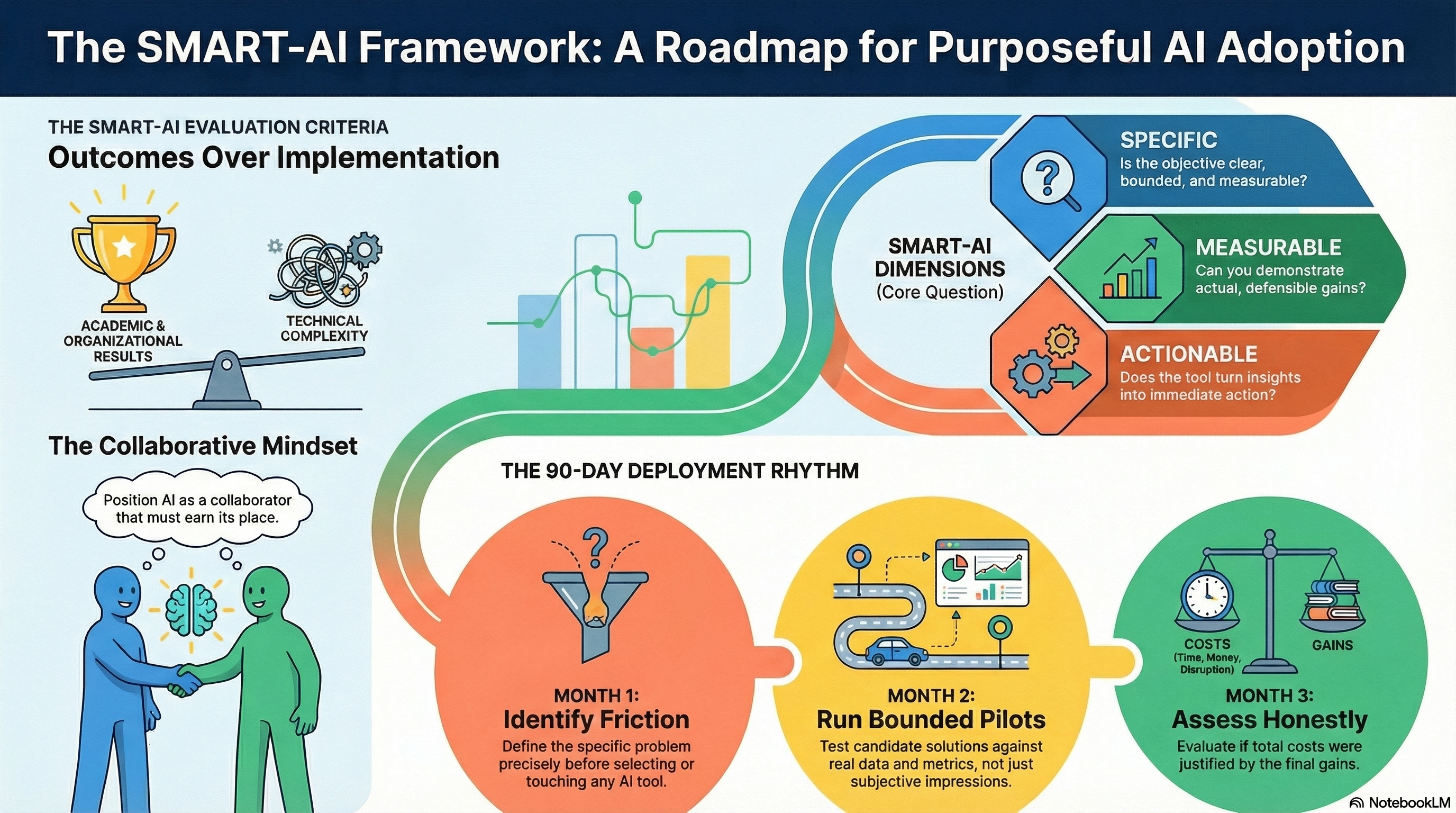
Notice what the framework does not ask: Is this the most powerful model? Is it the newest? Those questions are not irrelevant but instead are secondary. SMART-AI is fundamentally about outcomes, not implementations. The goal is to measure academic and organizational results, not to celebrate the technical complexity of the system producing them.
A 90-day path from idea to evidence
One of the most practical things about this framework is the accompanying deployment rhythm. Rather than a slow multi-year rollout or a chaotic all-at-once launch, it proposes a disciplined approach over three months (or other well-defined periods):
Month One | Identify the pain points Where is friction highest? What tasks consume disproportionate time with little value? Define the problem precisely before touching a tool. |
Month Two | Run a bounded pilot Test candidate solutions against real metrics. Not impressions — data. Does the AI produce the outcome you defined in month one? |
Month Three | Assess honestly Did it work? Can it scale? Was the total cost — time, money, disruption — justified by the gain? This is where most organizations flinch. Don't flinch. |
This rhythm matters because it builds an evidence base. At the Institute for Future Intelligence, where we are developing AI-integrated curriculum tools across everything from immunology education to engineering education, the temptation is always to build first and evaluate later. The SMART-AI framework insists on flipping that order.
"The goal is to measure academic outcomes, not technical implementations. Make existing systems smarter and more efficient."
What AI cannot replace — and why that matters
The framework closes with an observation that deserves more attention than it usually gets: the skills that AI cannot replicate are the ones most worth developing right now.
- Purpose-driven thinking: knowing why the goals matter
- Emotional intelligence: navigating the human dimensions of any endeavor
- Creativity: generating ideas that are solutions to current and relevant problems
- Ethical reasoning: making defensible judgments when uncertainty exists
- Narrative communication: translating complex findings into meaning others can act on
This serves as a map for implementation. As AI absorbs more of the routine analytical and procedural work, the comparative advantage of skilled humans shifts toward exactly these capabilities, so investing in these now is strategic.
The quiet revolution
What is most useful about SMART-AI is the worldview it assumes. It doesn't imagine AI as a force arriving from outside to reshape everything. It positions AI as a collaborator — one that must earn its place in the workflow by demonstrating specific, measurable, consistent value.
This revolution is happening now, incrementally, in institutions like ours, in courses redesigned around place-based data, in tutors that adapt to individual students, in research pipelines that compress weeks of literature review into hours. The transformation is quiet, human-centered, and extremely practical and efficient.
The winners in this era will not be those who chase distant frontiers. They will be the ones who see clearly, act deliberately, and build systems where human judgment and artificial intelligence move forward together. The future of AI is not something to wait for. It's something to work with right now.
SOURCE
McGovern, Sheamus. The AI Skill Flip: How Smart Professionals Are Reinventing Work (pp. 200–201). Function. Kindle Edition.