Abstract
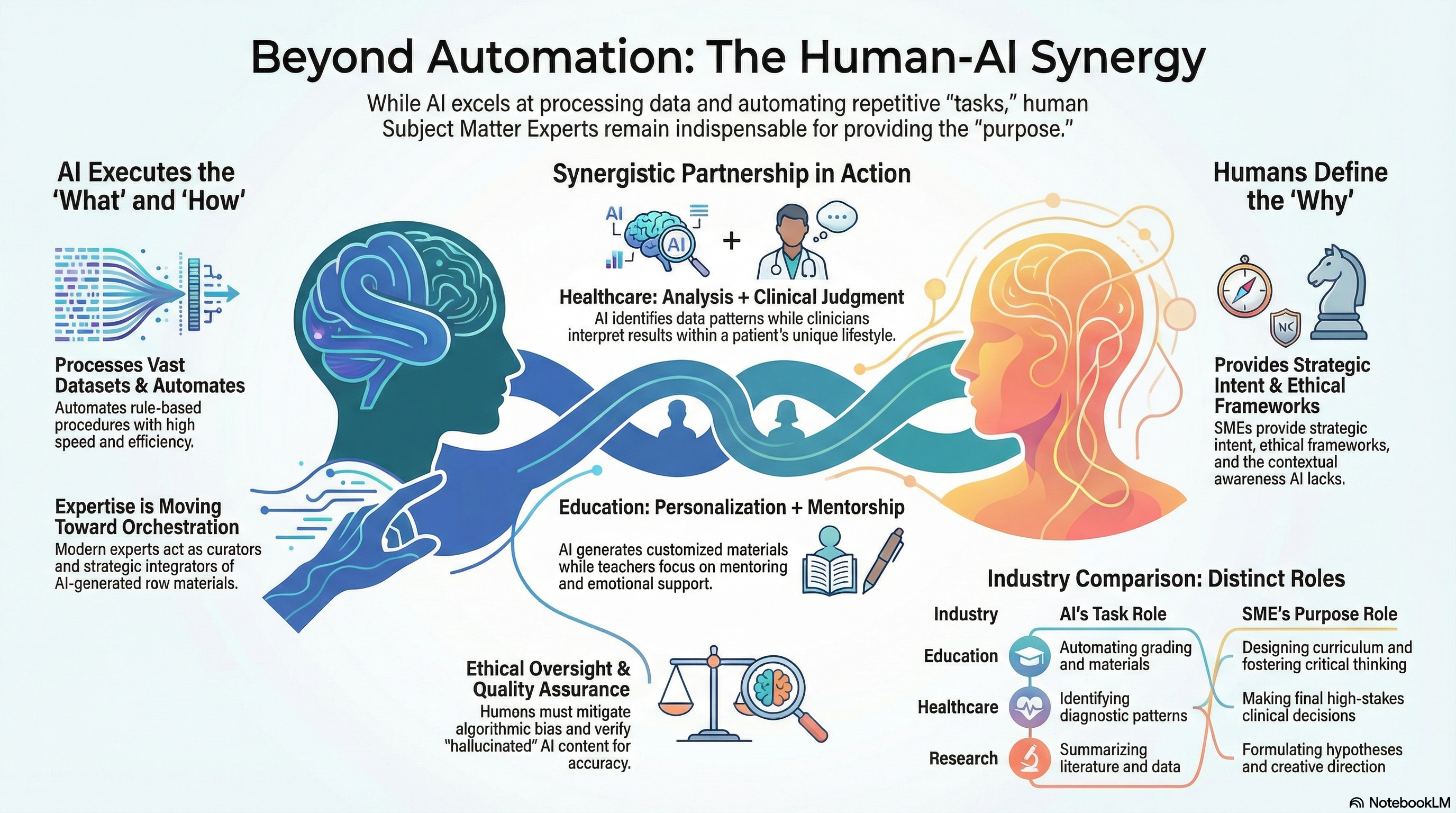
The rapid proliferation of Artificial Intelligence (AI), particularly generative models like ChatGPT and Gemini, has ignited a global discourse on the future of human labor and expertise. A prevailing narrative argues AI as a replacement for human roles, yet this perspective overlooks the fundamental limitations of current AI and the irreplaceable value of human intellect. This blog argues that the most effective and beneficial application of AI is not as an autonomous replacement but as a powerful tool that augments human capabilities. We argue that a clear distinction exists between AI's proficiency in task execution and the essential role of human Subject Matter Experts (SMEs) in defining and guiding the purpose of those tasks. Through an initial review of current literature, we explore this dynamic across critical domains including education, healthcare, scientific research, and the modern workplace. We find that AI excels at processing vast datasets, automating repetitive processes, and generating content at scale, thereby handling the 'what' and 'how' of a problem. However, SMEs remain indispensable for providing the 'why' or the contextual understanding, ethical oversight, critical judgment, and strategic direction that give tasks meaning and ensure their alignment with human values and goals to solve relevant problems. The optimal future is one of synergistic human-AI collaboration, a model of hybrid intelligence where AI serves as an extension of human knowledge, freeing experts to focus on higher-order cognitive functions like innovation, complex problem-solving, and empathetic engagement. This blog concludes that fostering this collaborative paradigm is essential for harnessing the full potential of AI to create a more efficient, equitable, and innovative society, ultimately amplifying rather than supplanting human expertise.
Introduction
The advent of advanced Artificial Intelligence (AI) has marked a pivotal moment in technological history, transforming industries and reshaping the landscape of scientific research (Ray, 2023). The public release of sophisticated generative AI models, such as ChatGPT and Gemini, has democratized access to powerful computational tools, leading to an era of unprecedented potential for content creation and data analysis (Pavlik, 2023). This technological surge has driven a pervasive narrative centered on automation and displacement, where AI is often framed as an impending substitute for human professionals across numerous fields. While AI's capacity to perform complex tasks is undeniable, this replacement-focused discourse often oversimplifies the nature of both intelligence and expertise.
The critical distinction that is frequently overlooked is the difference between task execution and purpose-driven action. Current AI systems, built on machine learning algorithms, are masters of the former; they can ingest and process information, recognize patterns, and generate outputs based on their training data with remarkable speed and efficiency (Nah, 2023). However, they lack genuine understanding, consciousness, and the intrinsic motivation that defines purpose. They can answer 'what' and 'how' based on the data they have seen, but they cannot independently determine 'why' a task should be done, whether its outcome is ethically sound, or how it fits into a broader strategic vision.
This is the domain of the human Subject Matter Expert (SME). Expertise is more than the accumulation of information; it is the cultivated ability to apply knowledge with nuance, to navigate ambiguity, to exercise critical judgment, and to innovate by connecting disparate concepts in novel ways. The future of progress, therefore, does not lie in a competition between human and machine, but rather in their collaboration (Nah, 2023). This blog argues that AI should be viewed not as a replacement for human experts but as a sophisticated tool that extends and enhances their capabilities. The most significant advancements will emerge from a synergistic partnership where AI handles the mundane, data-intensive, and repetitive tasks, thereby liberating human experts to focus on the strategic, creative, and ethical dimensions of their work.
This post will explore the symbiotic relationship between AI and SMEs across several key sectors. We will first delineate the distinct capabilities of AI in task execution versus the human role in defining purpose. Subsequently, we will examine the indispensable functions of SMEs, including contextualization, ethical oversight, and quality validation. We will then present case studies of successful human-AI collaboration in education, healthcare, the workplace, and scientific research. Finally, we will discuss the challenges and future directions of this collaborative paradigm, concluding that the path forward is not one of human obsolescence but of human amplification, powered by intelligent partnership with AI.
The Dichotomy of Task and Purpose
The discourse surrounding AI's impact is clarified by distinguishing between its role in executing 'tasks' and the human imperative to define 'purpose'. This distinction forms the foundation of the human-AI collaborative model, where each party contributes its unique strengths.
AI's Proficiency in Task Execution
Modern generative AI has demonstrated an extraordinary ability to perform a wide array of well-defined tasks that were once the exclusive domain of humans. These systems excel at processing and synthesizing information from vast datasets at a scale and speed unattainable by any individual (Ray, 2023). In education, AI can generate diverse instructional materials, from texts to videos, and create personalized learning paths for students (Mittal, 2024). In data science, AI and ML platforms can automate the process of feature engineering, model creation, and performance scoring, significantly accelerating the workflow of data scientists (Wang, 2019).
This task-oriented proficiency extends to creative and analytical domains. AI can assist in academic writing by processing data and generating initial drafts (Nguyen, 2024), and in medicine, it can analyze radiological images to detect anomalies with high precision (Reverberi, 2022) and pathology slides to make cancer diagnoses. The core strength of AI in these contexts is its ability to execute complex, rule-based, or pattern-driven procedures efficiently. It operates as a powerful engine for computation and content generation, handling the laborious and time-consuming aspects of a project. However, the outputs of these tasks are generated without an inherent understanding of their meaning, implications, or ultimate goal.
The Human Imperative of Purpose
Purpose is the domain of human intelligence. It encompasses the strategic intent, ethical framework, and contextual awareness that guide the application of any tool, including AI. While an AI can be instructed to write a research paper, it is the human researcher who defines the research question, determines the methodological rigor, and interprets the findings to contribute new knowledge to a field (Ray, 2023). Purpose involves asking 'why', a question that current AI cannot formulate or answer in a meaningful way.
This human-driven purpose is critical for several reasons. First, it provides direction. An SME sets the objectives that an AI system works towards, ensuring that its computational power is applied to solving relevant and important problems. Second, it provides an ethical compass. AI models can perpetuate and even amplify biases present in their training data (Klimova, 2022). It is the human expert's responsibility to identify these biases, assess the societal impact of an AI application, and ensure its deployment is fair, equitable, and safe (The Lancet, 2023). Third, it involves critical thinking and judgment. SMEs evaluate the outputs of AI, using their inherent deep understanding of a topic, distinguishing plausible-sounding falsehoods from genuine insights and integrating AI-generated information into a broader, coherent understanding of a problem (Rusandi, 2023).
In essence, AI provides the raw material such as the data analysis, the draft text, and the preliminary diagnosis while the human expert provides the intellectual architecture, refining, validating, and contextualizing that material to achieve a specific, meaningful goal.
The Indispensable Role of Subject Matter Experts
In the collaborative human-AI paradigm, the role of the SME is not diminished but rather transformed and elevated. They transition from being sole executors of tasks to becoming strategic directors, validators, and ethical guardians of AI-augmented processes. Their deep-seated knowledge and experience become more critical than ever for navigating the complexities and limitations of AI systems.
Contextualization and Nuanced Interpretation
AI models learn from data, but they lack lived experience and a deep understanding of the intricate, often nuanced, context that surrounds a problem. An SME possesses this tacit knowledge, allowing them to interpret AI outputs with a level of understanding that machines rarely replicate. For example, in medicine, an AI might flag a statistical anomaly in a patient's data, but a clinician (the SME) can interpret that anomaly in the context of the patient's lifestyle, family history, and co-morbidities to make an accurate diagnosis (Tate, 2023). In business, an AI can analyze market trends, but an experienced executive can contextualize those trends within the company's culture, competitive landscape, and long-term strategic goals (Angelopoulos, 2023). This ability to situate data within a broader, meaningful context is a uniquely human skill.
Ethical Oversight and Bias Mitigation
One of the most significant challenges facing AI is the problem of inherent bias. AI systems trained on historical data can learn and reproduce existing societal biases related to race, gender, and other characteristics (Ray, 2023). The consequences can be severe, leading to discriminatory outcomes in areas like hiring, loan applications, and even criminal justice. SMEs are the first line of defense against such algorithmic harm. Experts in fields like human-computer interaction (HCI) and machine learning (ML) are essential for designing and implementing fairness in the software design process (Ryan, 2023). They can scrutinize the training data, question the assumptions embedded in an algorithm, and evaluate the system's outputs for unintended consequences. This requires a deep understanding of both the technical aspects of the AI and the social context in which it will be deployed (Fotis, 2025).
Validation, Verification, and Quality Assurance
Generative AI is known for its ability to produce fluent and confident-sounding text, which can sometimes be inaccurate or entirely fabricated, a phenomenon known as "hallucination." This makes rigorous validation by human experts absolutely essential. In academic writing, any AI-generated content must be meticulously checked for factual accuracy and proper citation (Nesari, 2024). In medical education, when AI is used to generate assessment questions, subject matter experts must review and refine the content to ensure its clinical relevance and accuracy (Indran, 2024; White, 2025). This verification step is not a mere formality; it is a critical function that upholds standards of quality, accuracy, and reliability. The SME acts as the ultimate arbiter of truth, ensuring that AI-generated outputs are fit for purpose before they are deployed.
Innovation and Creative Direction
While AI can generate novel combinations of existing data, true innovation often requires a leap of intuition, a creative spark that challenges the status quo. This is a hallmark of human expertise. SMEs drive innovation by asking new questions, formulating bold hypotheses, and providing the creative direction for research and development. AI can support this process by rapidly exploring possibilities and generating data, but the strategic vision comes from the human expert. This human-AI co-creation model can lead to breakthroughs that neither could achieve alone (Wu, 2021). For instance, in materials science, machine learning can accelerate the discovery of new materials, but it is human creativity that guides the search and imagines novel applications (Ozin, 2018). The SME's role is to steer the powerful engine of AI toward uncharted territory, fostering genuine discovery rather than mere optimization.
Synergistic Human-AI Collaboration Across Domains
The theoretical framework of human-AI collaboration, distinguishing task from purpose, is best illustrated through its practical application in various fields. Across education, healthcare, and the broader workplace, a model of hybrid intelligence is emerging, where the combination of human and artificial intelligence achieves superior results (Dellermann, 2019).
Education
In the educational sector, AI is rapidly becoming a transformative tool for both students and educators (Paek, 2021).
- AI's Task Role: AI systems can perform tasks such as automating the grading of assignments, providing personalized feedback, and generating customized learning materials to suit individual student needs (Crompton, 2021). Conversational AI can act as a tireless tutor, offering students opportunities for language practice outside the classroom (Ji, 2022).
- SME's Purpose Role: The teacher, as the pedagogical SME, defines the purpose of these tools. They design the overall curriculum, determine the learning objectives, and foster a classroom environment that encourages critical thinking and collaboration (Sanusi, 2022). Teachers use AI-generated content as a starting point, refining it for accuracy and pedagogical value (Kindenberg, 2025). This collaboration allows teachers to offload administrative burdens and focus on higher-value activities like mentoring, facilitating complex discussions, and addressing the emotional needs of their students (Kim, 2023).
Healthcare
Healthcare is a high-stakes environment where the synergy between AI's analytical power and human clinical judgment is paramount (Olawade, 2024).
- AI's Task Role: AI algorithms excel at analyzing medical data, such as identifying patterns in diagnostic images, predicting patient risk factors from electronic health records, and optimizing hospital operations (Udegbe, 2024). These tools can serve as powerful decision-support systems for clinicians.
- SME's Purpose Role: The clinician remains the ultimate decision-maker. Experimental evidence shows that while clinicians are influenced by AI suggestions, they weigh this advice against their own expertise, leading to a hybrid team that outperforms either the human or the AI alone (Reverberi, 2022). The physician's purpose is to integrate the AI's quantitative analysis with the qualitative aspects of patient care (Sharma, 2023). This ensures that technology serves, rather than dictates, the practice of medicine (Newman, 2021).
The Workplace and Scientific Research
In corporate and research settings, human-AI collaboration is driving innovation and efficiency.
- AI's Task Role: AI tools automate routine business processes, analyze vast datasets for market insights, and assist in the development of new products (Aldoseri, 2024) such as novel therapeutics and proteins designed de novo. In research, AI can accelerate discovery by generating hypotheses, summarizing literature, and analyzing experimental data (Ray, 2023).
- SME's Purpose Role: The human expert provides the strategic direction. Data scientists, for instance, express optimism that their future involves collaborating with AI systems, where their expertise is indispensable for interpreting models and aligning them with business objectives (Wang, 2019). Similarly, academic researchers who engage in highly interactive and iterative processes with AI tools tend to achieve better performance, using their expertise to guide the AI's generative capabilities toward a high-quality outcome (Nguyen, 2024). The SME's role is to ensure that the application of AI is not just technically sound but also strategically relevant and scientifically valid.
Discussion
The transition towards a human-AI collaborative paradigm is not without its challenges, but it signals a fundamental evolution in the nature of expertise and work. This shift requires a re-evaluation of skills, a focus on building trust, and a proactive approach to designing systems that facilitate, rather than hinder, effective partnership.
The Evolution of Expertise
The rise of AI does not render human expertise obsolete; it redefines it. The value of an SME is shifting from being a repository of encyclopedic knowledge, a function that AI can increasingly replicate, to being a curator, validator, and strategic integrator of information. The modern expert must not only possess deep domain knowledge but also develop AI literacy. This includes understanding how AI models work, recognizing their limitations, and mastering the art of prompt engineering to elicit the most useful outputs. Expertise now involves the ability to orchestrate a hybrid team of human and artificial intelligence, leveraging the strengths of each to solve complex problems (Potanin, 2023).
Challenges in Human-AI Collaboration
Several obstacles must be addressed to realize the full potential of this synergistic model.
- Trust and Transparency: Many advanced AI models operate as "black boxes," making it difficult for users to understand their reasoning. This lack of transparency can erode trust and hinder effective collaboration. Future research must focus on developing more interpretable AI and including human experts as co-designers in the development process to build trustworthy systems (Duan, 2023).
- Over-reliance and Skill Atrophy: A significant risk is that humans may become overly reliant on AI, leading to "metacognitive laziness" and a degradation of critical thinking skills (Fan, 2024). Educational systems and workplace training programs must emphasize that AI is a tool to assist, not replace, human cognition. The goal should be to use AI to offload lower-level tasks, freeing up mental bandwidth for more demanding analytical and creative work.
- Ethical and Accountability Frameworks: As AI becomes more integrated into high-stakes decision-making, clear frameworks for accountability are needed (Ray, 2023). When a human-AI team makes a mistake, who is responsible? Establishing clear guidelines for the ethical use of AI, ensuring data privacy, and defining liability are critical steps for fostering a safe and reliable collaborative environment (Familoni, 2024).
Future Directions
The path forward lies in the intentional design of systems and organizations that support "hybrid intelligence." This involves more than simply giving experts access to AI tools; it requires a fundamental rethinking of workflows, team structures, and educational curricula. Future research should focus on the cognitive and social dynamics of human-AI teams to understand how to optimize collaboration (Ryoo, 2025). Educational institutions must integrate AI literacy and critical thinking skills into their programs to prepare the next generation of professionals for this new reality (Dellermann, 2019). Ultimately, the goal is to foster a symbiotic relationship where humans and AI learn from each other, leading to continuous improvement and enhanced collective intelligence (Ji, 2022).
Conclusion
The narrative of artificial intelligence as a wholesale replacement for human expertise is a compelling but ultimately flawed simplification of a complex technological and social transformation. While AI's proficiency at executing tasks with unprecedented speed and scale is revolutionizing industries, it remains a tool that lacks the consciousness, critical judgment, and contextual understanding that are the hallmarks of human intelligence. The true potential of AI will be unlocked not by pursuing full autonomy, but by embracing a model of deep, synergistic collaboration between humans and machines.
This post has argued for a clear demarcation between AI's role in handling the 'what' and 'how' of task execution and the indispensable role of Subject Matter Experts in defining the 'why', the purpose, ethics, and strategic direction that give these tasks meaning. Across education, healthcare, research, and the workplace, the most effective applications of AI are those that augment, rather than replace, human professionals. By automating the mundane and data-intensive aspects of their work, AI empowers experts to focus on the higher-order cognitive functions where they create the most value: strategic thinking, creative problem-solving, nuanced interpretation, and empathetic human interaction.
The path forward requires a conscious effort to cultivate this collaborative ecosystem. This involves designing transparent and trustworthy AI systems, developing new educational frameworks that foster AI literacy alongside critical thinking, and establishing clear ethical guidelines to govern human-AI partnerships. The role of the expert is not disappearing; it is evolving into one of a conductor, orchestrating the powerful capabilities of AI to achieve goals that are ambitious, innovative, and aligned with human values. By shifting our focus from replacement to amplification, we can harness AI as a transformative extension of human knowledge, paving the way for a future where technology serves to elevate our collective intelligence and enhance our capacity to solve the world's most pressing challenges.
References
Aldoseri, A, Al‐Khalifa, K, & Hamouda, A (2024). AI-Powered Innovation in Digital Transformation: Key Pillars and Industry Impact. Sustainability, 16(5), 1790-1790. https://doi.org/10.3390/su16051790
Angelopoulos, S, Bendoly, E, Fransoo, J, Hoberg, K, Ou, C, & Tenhiälä, A (2023). Digital transformation in operations management: Fundamental change through agency reversal. Journal of Operations Management, 69(6), 876-889. https://doi.org/10.1002/joom.1271
Crompton, H, & Song, D (2021). The Potential of Artificial Intelligence in Higher Education. Revista Virtual Universidad Católica del Norte, (62), 1-4. https://doi.org/10.35575/rvucn.n62a1
Dellermann, D, Calma, A, Lipusch, N, Weber, T, Weigel, S, & Ebel, P (2019). The Future of Human-AI Collaboration: A Taxonomy of Design Knowledge for Hybrid Intelligence Systems. Proceedings of the ... Annual Hawaii International Conference on System Sciences/Proceedings of the Annual Hawaii International Conference on System Sciences, . https://doi.org/10.24251/hicss.2019.034
Duan, X, Pei, B, Ambrose, G, Hershkovitz, A, Cheng, Y, & Wang, C (2023). Towards transparent and trustworthy prediction of student learning achievement by including instructors as co-designers: a case study. Education and Information Technologies, 29(3), 3075-3096. https://doi.org/10.1007/s10639-023-11954-8
Familoni, B (2024). CYBERSECURITY CHALLENGES IN THE AGE OF AI: THEORETICAL APPROACHES AND PRACTICAL SOLUTIONS. Computer Science & IT Research Journal, 5(3), 703-724. https://doi.org/10.51594/csitrj.v5i3.930
Fan, Y, Tang, L, Le, H, Shen, K, Tan, S, Zhao, T, Shen, Y, Li, X, & Gašević, D (2024). Beware of metacognitive laziness: Effects of generative artificial intelligence on learning motivation, processes, and performance. British Journal of Educational Technology, 56(2), 489-530. https://doi.org/10.1111/bjet.13544
Fotis, T, Kioskli, K, & Seralidou, E (2025). Charting Trustworthiness: A Socio-Technical Perspective on AI and Human Factors. AHFE international, 168. https://doi.org/10.54941/ahfe1006137
Indran, IR, Paranthaman, P, Gupta, N, & Mustafa, N (2024). Twelve tips to leverage AI for efficient and effective medical question generation: A guide for educators using Chat GPT. Medical teacher, 46(8), 1021-1026. https://doi.org/10.1080/0142159X.2023.2294703
Ji, H, Han, I, & Ko, Y (2022). A systematic review of conversational AI in language education: focusing on the collaboration with human teachers. Journal of Research on Technology in Education, 55(1), 48-63. https://doi.org/10.1080/15391523.2022.2142873
Kim, J (2023). Leading teachers' perspective on teacher-AI collaboration in education. Education and Information Technologies, 29(7), 8693-8724. https://doi.org/10.1007/s10639-023-12109-5
Kindenberg, B (2025). The Role of AI in Historical Simulation Design: A TPACK Perspective on a French Revolution Simulation Design Experience. Education Sciences, 15(2), 192-192. https://doi.org/10.3390/educsci15020192
Klimova, B, Pikhart, M, & Kacetl, J (2022). Ethical issues of the use of AI-driven mobile apps for education. Frontiers in public health, 10, 1118116. https://doi.org/10.3389/fpubh.2022.1118116
Mittal, U, Sai, S, Chamola, V, & Devika, (2024). A Comprehensive Review on Generative AI for Education. IEEE Access, 12, 142733-142759. https://doi.org/10.1109/access.2024.3468368
Nah, F, Zheng, R, Cai, J, Siau, K, & Chen, L (2023). Generative AI and ChatGPT: Applications, challenges, and AI-human collaboration. Journal of Information Technology Case and Application Research, 25(3), 277-304. https://doi.org/10.1080/15228053.2023.2233814
Nesari, T (2024). The emergence of ChatGPT: An opportunity or adversity for scholarly communications. International Journal of Ayurveda Research, 5(1), 1-1. https://doi.org/10.4103/ijar.ijar_7_24
Newman, MB (2021). Artificial Intelligence and Case Management: Embracing Transformative Practice. Professional case management, 26(6), 304-306. https://doi.org/10.1097/NCM.0000000000000533
Nguyen, A, Hong, Y, Dang, B, & Huang, X (2024). Human-AI collaboration patterns in AI-assisted academic writing. Studies in Higher Education, 49(5), 847-864. https://doi.org/10.1080/03075079.2024.2323593
Olawade, D, David-Olawade, A, Wada, O, Asaolu, A, Adereni, T, & Ling, J (2024). Artificial intelligence in healthcare delivery: Prospects and pitfalls. Journal of Medicine Surgery and Public Health, 3, 100108-100108. https://doi.org/10.1016/j.glmedi.2024.100108
Ozin, G, & Siler, T (2018). Catalyst: New Materials Discovery: Machine-Enhanced Human Creativity. Chem, 4(6), 1183-1189. https://doi.org/10.1016/j.chempr.2018.05.011
Paek, S, & Kim, N (2021). Analysis of Worldwide Research Trends on the Impact of Artificial Intelligence in Education. Sustainability, 13(14), 7941-7941. https://doi.org/10.3390/su13147941
Pavlik, J (2023). Collaborating With ChatGPT: Considering the Implications of Generative Artificial Intelligence for Journalism and Media Education. Journalism & Mass Communication Educator, 78(1), 84-93. https://doi.org/10.1177/10776958221149577
Potanin, M, Holtkemper, M, & Beecks, C (2023). The impact of automation frameworks on today's data science competencies. AHFE international, 111. https://doi.org/10.54941/ahfe1004012
Ray, P (2023). ChatGPT: A comprehensive review on background, applications, key challenges, bias, ethics, limitations and future scope. Internet of Things and Cyber-Physical Systems, 3, 121-154. https://doi.org/10.1016/j.iotcps.2023.04.003
Reverberi, C, Rigon, T, Solari, A, Hassan, C, Cherubini, P, GI Genius CADx Study Group, , & Cherubini, A (2022). Experimental evidence of effective human-AI collaboration in medical decision-making. Scientific reports, 12(1), 14952. https://doi.org/10.1038/s41598-022-18751-2
Rusandi, MA, Ahman, , Saripah, I, Khairun, DY, & Mutmainnah, (2023). No worries with ChatGPT: building bridges between artificial intelligence and education with critical thinking soft skills. Journal of public health (Oxford, England), 45(3), e602-e603. https://doi.org/10.1093/pubmed/fdad049
Ryan, S, Nadal, C, & Doherty, G (2023). Integrating Fairness in the Software Design Process: An Interview Study With HCI and ML Experts. IEEE Access, 11, 29296-29313. https://doi.org/10.1109/access.2023.3260639
Ryoo, Y, Bakpayev, M, Jeon, Y, Kim, K, & Yoon, S (2025). High hopes, hard falls: consumer expectations and reactions to AI-human collaboration in advertising. International Journal of Advertising, , 1-33. https://doi.org/10.1080/02650487.2025.2458996
Sanusi, I, Olaleye, S, Oyelere, S, & Dixon, R (2022). Investigating learners’ competencies for artificial intelligence education in an African K-12 setting. Computers and Education Open, 3, 100083-100083. https://doi.org/10.1016/j.caeo.2022.100083
Sharma, A, Lin, I, Miner, A, Atkins, D, & Althoff, T (2023). Human–AI collaboration enables more empathic conversations in text-based peer-to-peer mental health support. Nature Machine Intelligence, 5(1), 46-57. https://doi.org/10.1038/s42256-022-00593-2
Tate, S, Fouladvand, S, Chen, JH, & Chen, CA (2023). The ChatGPT therapist will see you now: Navigating generative artificial intelligence's potential in addiction medicine research and patient care. Addiction (Abingdon, England), 118(12), 2249-2251. https://doi.org/10.1111/add.16341
The Lancet, (2023). AI in medicine: creating a safe and equitable future. Lancet (London, England), 402(10401), 503. https://doi.org/10.1016/S0140-6736(23)01668-9
Udegbe, F, Ebulue, O, Ebulue, C, & Ekesiobi, C (2024). THE ROLE OF ARTIFICIAL INTELLIGENCE IN HEALTHCARE: A SYSTEMATIC REVIEW OF APPLICATIONS AND CHALLENGES. International Medical Science Research Journal, 4(4), 500-508. https://doi.org/10.51594/imsrj.v4i4.1052
Wang, D, Weisz, J, Müller, M, Ram, P, Geyer, P, Dugan, C, Tausczik, Y, Samulowitz, H, & Gray, A (2019). Human-AI Collaboration in Data Science. Proceedings of the ACM on Human-Computer Interaction, 3(CSCW), 1-24. https://doi.org/10.1145/3359313
White, S, Trotter, S, McAtee, R, & Bearden, V (2025). Advancing Geriatric Care: Harnessing AI and Human Expertise to Enhance CNA Training. Innovation in Aging, 9(Supplement_2). https://doi.org/10.1093/geroni/igaf122.2238
Wu, Z, Ji, D, Yu, K, Zeng, X, Wu, D, & Shidujaman, M (2021). AI Creativity and the Human-AI Co-creation Model. Lecture notes in computer science, , 171-190. https://doi.org/10.1007/978-3-030-78462-1_13
Ziakkas, D, St‐Hilaire, M, & Pechlivanis, K (2024). The role of digital twins in the certification of the Advanced Air Mobility (AAM) systems. AHFE international, . https://doi.org/10.54941/ahfe1004512