Abstract
Artificial intelligence (AI), once a concept confined to theoretical computer science, has evolved into a transformative force reshaping industries and societies. This review provides a comprehensive overview of the trajectory of AI, from its conceptual origins to the current era dominated by sophisticated machine learning models. We trace the historical milestones, including periods of rapid advancement and "AI winters," that have shaped the field. A central focus is placed on machine learning (ML) as the primary engine of modern AI, with a detailed exploration of its subfield, deep learning (DL), which has enabled breakthroughs in perception and cognition. We then examine the recent paradigm shift brought about by the advent of large language models (LLMs) and generative AI (GenAI) in general, introducing the underlying technologies behind their remarkable capabilities. The review extensively documents the current, tangible impacts of AI across diverse sectors, including accelerated scientific discovery, enhanced medical diagnostics, personalized education, and optimized industrial processes. Finally, we explore the future societal implications of AI, with a critical analysis of its potential effects on workforce development, the changing landscape of employment, and the urgent need for educational reform. We conclude by discussing the profound ethical, governance, and regulatory challenges that accompany these powerful technologies, emphasizing the necessity of a human-centric approach to steer the future of AI toward equitable and beneficial outcomes for humanity.
Introduction
Artificial intelligence (AI) represents the broad scientific endeavor to create machines capable of performing tasks that typically require human intelligence, such as visual perception, speech recognition, decision-making, and language translation (Bini, 2018). The concept has captivated human imagination for centuries, but it was only in the mid-20th century that it formalized into a distinct academic discipline. The journey of AI has been characterized by cycles of fervent optimism and periods of disillusionment, but the last two decades have witnessed an unprecedented acceleration in its capabilities, driven by the confluence of massive datasets, powerful computing hardware, and algorithmic innovations (Aggarwal, 2022).
At the heart of this modern AI revolution is machine learning (ML), a subfield focused on developing algorithms that allow computers to learn from and make predictions or decisions based on data, without being explicitly programmed for the task (Panch, 2018). A further specialization within ML, known as deep learning (DL), utilizes complex, multi-layered artificial neural networks to model and understand intricate patterns in data, leading to state-of-the-art performance in areas like image recognition and natural language processing (Wang, 2020).
More recently, the emergence large language models, a form of generative AI, has marked another significant inflection point (Kalota, 2024). These models, trained on vast expanses of text and data, can generate coherent, contextually relevant, and often sophisticated human-like text, enabling a new generation of applications from advanced chatbots to tools for scientific discovery (Kang, 2024). The rapid proliferation of these technologies is already having a profound impact on society, transforming scientific research, healthcare delivery, education, and the nature of work itself (Wang, 2019).
This review aims to provide a holistic perspective on the field of artificial intelligence. We begin by tracing its historical development, followed by an examination of the foundational role of machine learning and deep learning. We then delve into the technological underpinnings and capabilities of large language models. The subsequent sections are dedicated to a comprehensive analysis of the current and future societal impacts of AI, with a particular focus on its implications for education, workforce development, and the evolving landscape of employment. By synthesizing research from diverse domains, this paper seeks to illuminate the multifaceted nature of the AI revolution and the critical conversations required to navigate its course responsibly.
The Genesis and Evolution of Artificial Intelligence
The intellectual roots of AI can be traced back to antiquity, with myths of artificial beings and philosophical inquiries into the nature of reason. However, the formal establishment of AI as a scientific discipline occurred at the 1956 Dartmouth Summer Research Project on Artificial Intelligence. It was here that the term "artificial intelligence" was coined, and the field's foundational goals were articulated: to create machines that could use language, form abstractions and concepts, solve kinds of problems now reserved for humans, and autonomously improve themselves.
The initial years were marked by considerable enthusiasm, with pioneering work in areas like problem-solving (the Logic Theorist) and natural language processing (ELIZA). This early success, however, was largely confined to narrowly defined problems. As researchers attempted to tackle more complex, real-world challenges, they encountered significant obstacles, most notably the limitations of computational power and the immense difficulty of encoding the vast amount of implicit knowledge humans use in everyday reasoning. This led to the first "AI winter" in the mid-1970s, a period of reduced funding, waning interest and little progress.
The 1980s saw a resurgence with the rise of "expert systems," a form of AI that captured the knowledge of human experts in a specific domain (e.g., medical diagnosis) as a set of rules. These systems achieved considerable commercial success and demonstrated the practical value of AI. Yet, they were brittle, expensive to build and maintain, and unable to learn or adapt. The limitations of this rule-based approach, coupled with the collapse of a specialized hardware market, led to a second AI winter in the late 1980s and early 1990s.
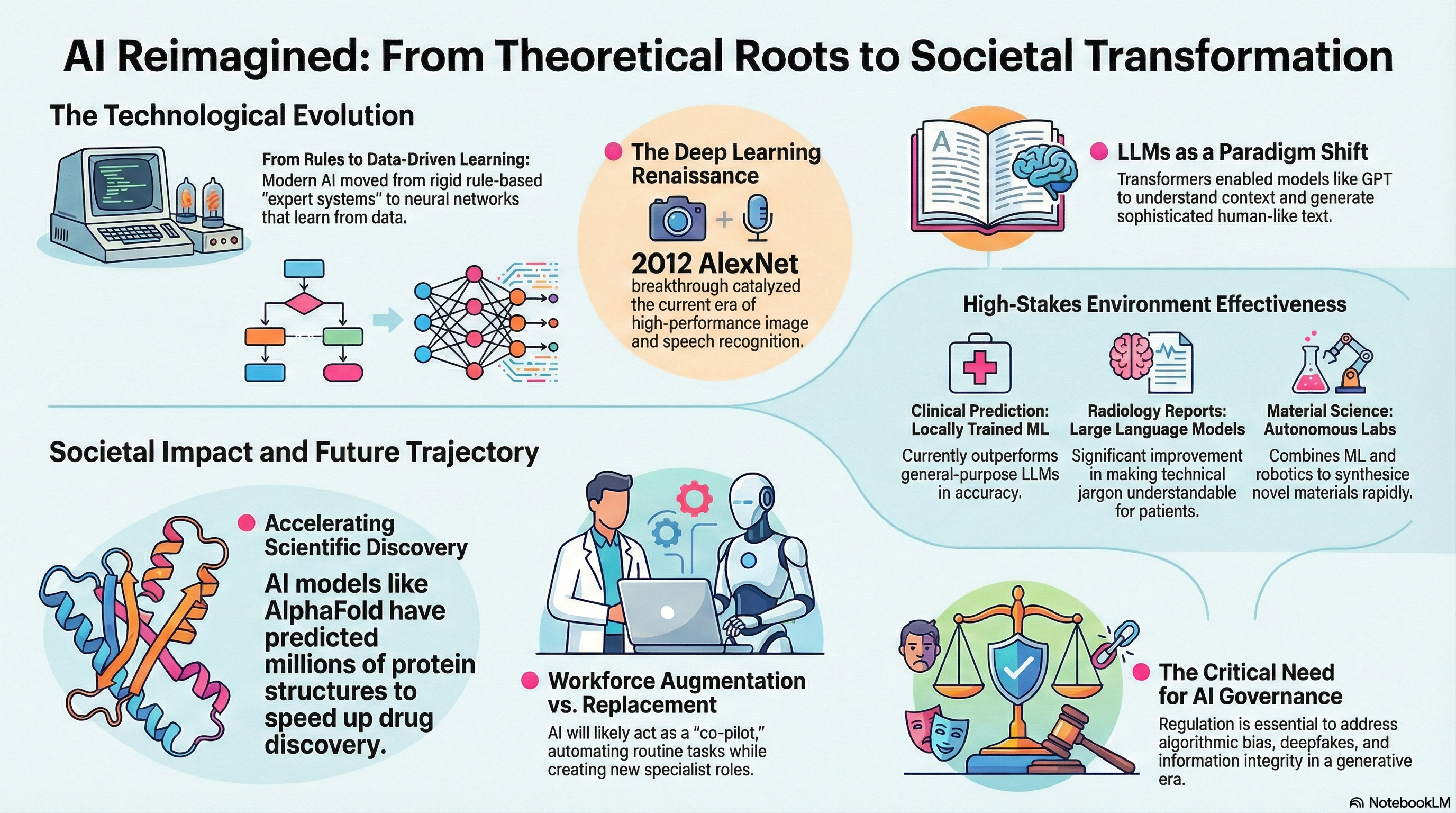
The modern era of AI began to dawn in the late 1990s and accelerated dramatically in the 2010s. This renaissance was not driven by a single breakthrough but by a perfect storm of enabling factors: the exponential growth of computing power, the availability of "big data" from the internet and other digital sources, and the revival of an older idea, artificial neural networks (ANN), supercharged into what is now known as deep learning. This shift marked a fundamental change from programming intelligence through explicit rules to enabling systems to learn intelligence from data.
Machine Learning: The Engine of Modern AI
The defining characteristic of modern AI is its reliance on machine learning (ML), a paradigm that allows systems to improve their performance on a task through experience, typically in the form of data (Ghahramani, 2015). Instead of being hand-coded with instructions for every eventuality, an ML model is trained on a dataset, from which it learns to recognize patterns and make predictions. The quality and quantity of data are therefore paramount to the success of any ML application, making data collection and labeling a critical bottleneck in the development process (Roh, 2019).
ML encompasses a wide array of techniques, but the most transformative in recent years has been deep learning (DL). DL is a subset of ML based on artificial neural networks (ANNs) with many layers (hence "deep") (Bini, 2018). These networks are inspired by the structure of the human brain and are capable of learning hierarchical representations of data. For example, in an image recognition task, the initial layers of a deep neural network might learn to detect simple features like edges and colors, while deeper layers combine these features to recognize more complex patterns like shapes, objects, and eventually, entire scenes.
The breakthrough moment for deep learning came in 2012 when a DL model called AlexNet dramatically outperformed all other methods in the ImageNet Large Scale Visual Recognition Challenge. This success catalyzed a wave of research and investment, leading to rapid advancements and the application of DL to a vast range of problems. Today, deep learning is the foundational technology behind many AI applications, from the voice assistants on our smartphones to advanced systems for medical diagnosis (Liang, 2019), robotics (Soori, 2023), and drug discovery (Gupta, 2021).
The Rise of Large Language Models: A Paradigm Shift
While deep learning revolutionized tasks related to perception, its impact on natural language processing (NLP) was initially more incremental. This changed with the development of the Transformer architecture in 2017, a novel neural network design that proved exceptionally effective at handling sequential data like text. The Transformer, and its key mechanism of "self-attention," allowed models to weigh the importance of different words in a sentence, enabling a more nuanced understanding of context and long-range dependencies.
This architectural innovation paved the way for the creation of Large Language Models (LLMs). LLMs are massive deep learning models, often with hundreds of billions of parameters, that are pre-trained on colossal amounts of text data scraped from the internet and digitized books. They are trained using a "self-supervised" objective, such as predicting the next word in a sentence. Through this simple process, repeated billions of times across a diverse corpus, the models learn intricate statistical patterns of language, grammar, reasoning, and even a significant amount of factual knowledge about the world.
The result is a class of models, such as OpenAI's GPT series and Google's LaMDA, with astonishing generative capabilities (Sejnowski, 2023). They can write essays, generate computer code, translate languages, summarize complex documents, and engage in coherent, open-ended dialogue. This has led to a philosophical debate about whether these models truly "understand" language or are merely sophisticated stochastic parrots, brilliantly mimicking patterns without any underlying comprehension (Arcas, 2022). Regardless of the answer, their practical utility is undeniable, and they represent a significant step toward more general and flexible AI systems. The capabilities of LLMs are now being applied to tasks far beyond simple text generation, including complex scientific problems like predicting the three-dimensional structure of proteins from their amino acid sequence (Lin, 2023).
Current Societal Impact of Artificial Intelligence
The theoretical advancements in AI, ML, and LLMs have translated into a wide array of real-world applications that are actively reshaping society. The impact is pervasive, touching nearly every sector of the economy and daily life.
Science and Research
AI is fundamentally changing the scientific method, accelerating the pace of discovery. In materials science, autonomous laboratories use a combination of machine learning, historical data, and robotics to plan and execute experiments, leading to the rapid synthesis of novel materials (Szymanski, 2023). Similarly, AI is being applied to design high-performance composites (Wang, 2024) and to explore complex electrochemical reactions by integrating ML with LLMs to mine literature and optimize experiments (Zheng, 2025).
In the life sciences, one of the most celebrated achievements is the use of AI to predict protein structures, a long-standing grand challenge in biology. Models like AlphaFold and others have produced millions of computed structure models, which are now integrated into public databases and accessible to researchers worldwide (Burley, 2023). This capability is accelerating research in drug discovery, a field where AI is also used for virtual screening, molecule generation, and predicting drug efficacy (Guan, 2024; Tanoli, 2021).
Healthcare and Medicine
The medical field is a prime area for AI application, with the potential to improve diagnostics, personalize treatments, and streamline operations. AI algorithms have demonstrated performance comparable to experienced physicians in diagnosing diseases from medical images and electronic health records (EHRs) (Liang, 2019). AI is being applied across numerous specialties, including oncology for improved cancer detection and treatment planning (Zhang, 2023), hepatology for managing liver diseases and transplantation (Bhat, 2023; Ahn, 2021), and nutrition science for dietary assessment and personalized recommendations (Theodore Armand, 2024).
LLMs are also entering the clinical sphere. They are being used to streamline the creation of ML models for clinical studies (Tayebi Arasteh, 2024) and to improve the readability of complex medical documents like radiology reports, making them more accessible to patients (Butler, 2024; Butler, 2024). However, their use as direct sources of medical information or for clinical prediction requires caution, as they can provide less accurate or reliable answers compared to specialized models or established guidelines (Brown, 2025; Reicher, 2025; Tokgöz Kaplan, 2025). Studies evaluating LLMs for patient queries in fields like orthodontics (Makrygiannakis, 2024), sarcoma (Valentini, 2024), and postoperative support show promising but variable performance (Hurley, 2024; Abi-Rafeh, 2024).
Education
In education, AI is poised to create more personalized and effective learning experiences. Tools like ChatGPT and Gemini can be used to generate educational content, automate the grading of assignments, and provide students with instant feedback and support (Javaid, 2023). This allows educators to focus more on higher-level instruction and mentoring. The integration of AI and LLMs is creating a "new academic reality," prompting discussions about curriculum design, assessment methods, and the very nature of research and scholarly publishing (Lund, 2023; Alqahtani, 2023).
Other Industries
The impact of AI extends across numerous other sectors. In logistics, ML is used to optimize supply chains, predict demand, and automate warehouse operations (Woschank, 2020). In software engineering, LLMs are being used as assistants to help developers write, debug, and document code more efficiently (Özkaya, 2023). In business and management, AI is leveraged for everything from customer service chatbots to complex data analytics for strategic decision-making (Guler, 2023). Even fields like architecture are beginning to use AI to assist in low-carbon design and environmental impact assessment (Płoszaj-Mazurek, 2024).
Future Trajectories and Societal Implications
As AI capabilities continue to advance, their societal impact will deepen, presenting both immense opportunities and significant challenges. Navigating this future requires proactive planning and a visionary assessment of the potential transformations ahead, particularly concerning the workforce and education.
The Workforce of the Future
The most debated impact of AI is on the future of work. The automation of routine cognitive and manual tasks is expected to displace jobs in certain sectors, from data entry to transportation (Wang, 2019). However, historical technological revolutions suggest that while some jobs are eliminated, new ones are created. The AI era is likely to generate demand for new roles such as AI specialists, data scientists, robotics engineers, and AI ethicists.
More broadly, AI is expected to function as an augmentation tool, enhancing human capabilities rather than simply replacing them. In medicine, for example, AI can act as a powerful diagnostic aid, freeing up clinicians to spend more time on patient interaction and complex decision-making (Hanna, 2025). This human-AI collaboration will likely become the dominant work paradigm across many professions. More importantly, the role of AI as the tools to carry out prescribed tasks are emerging with human intervention to provide purpose for these tools, ensuring they are applied to the right problems in the right ways. The key challenge for society will be managing the transition, which will require robust social safety nets, and extensive programs for reskilling and upskilling the existing workforce to adapt to new roles and technologies.
Education in the AI Era
The changing demands of the workforce necessitate a fundamental rethinking of education. Rote memorization and procedural skills, which are easily automated, will become less valuable. Instead, educational systems must prioritize skills that are complementary to AI, such as critical thinking, creativity, complex problem-solving, emotional intelligence, and collaboration. AI literacy will become a fundamental competency for all citizens.
Curricula will need to be updated to incorporate these new priorities, and teaching methods will evolve to leverage AI as a personalized learning assistant (Plevris, 2025). The concept of education will also shift from a finite period in early life to a continuous process of lifelong learning, as the pace of technological change will require workers to constantly update their skills throughout their careers. Higher education and vocational training institutions will play a critical role in providing flexible, accessible, and relevant learning opportunities for people at all life stages and must also adapt to this changing reality.
Ethical and Governance Challenges
The rapid deployment of AI systems raises profound ethical and governance issues that must be addressed to ensure a positive societal outcome. One of the most pressing concerns is algorithmic bias. AI models trained on historical data can inherit and amplify existing societal biases related to race, gender, and other protected characteristics, leading to unfair or discriminatory outcomes in areas like hiring, loan applications, and criminal justice (Hanna, 2025).
The rise of generative AI has also created new challenges. The ability to generate highly realistic but fake text, images, and videos (deepfakes) poses a significant threat to information integrity and can be used for malicious purposes such as spreading misinformation, creating propaganda, and perpetrating fraud (Ferrara, 2024). In academia and publishing, the use of LLMs raises complex questions about authorship, plagiarism, and the integrity of scientific knowledge (Flanagin, 2023).
Addressing these challenges requires the development of robust regulatory frameworks. This includes establishing standards for transparency, accountability, and safety in AI systems, particularly in high-stakes domains like healthcare (Gerke, 2020). It also involves fostering public dialogue and engaging a wide range of stakeholders—including technologists, social scientists, ethicists, policymakers, and the public—in shaping the norms and laws that will govern the development and use of AI. The future of AI will see greater integration with other emerging technologies like the Internet of Things (IoT), creating new opportunities but also new security and privacy challenges (Alwahedi, 2024; Paramesha, 2024).
Discussion
The journey of artificial intelligence from a niche academic pursuit to a globally transformative technology has been remarkable. The current wave of progress, fueled by machine learning and now supercharged by large language models, is distinct from previous cycles of AI development in its breadth and real-world applicability. We are moving from AI systems that can perform narrow, specific tasks to more general, accessible and flexible tools that can augment human intellect across a vast spectrum of activities.
This review has highlighted the profound impact AI is already having in science, medicine, and education, acting as a powerful catalyst for innovation and efficiency. The ability of AI to analyze massive datasets and uncover complex patterns is unlocking new frontiers of knowledge, from the atomic scale of proteins to the vast complexity of human disease. In education and the workplace, AI promises a future of personalized support and human-machine collaboration, potentially leading to greater productivity and more fulfilling work.
However, this optimistic vision must be tempered by a realistic appraisal of the challenges. The dual-use nature of AI means that the same technologies that can accelerate scientific discovery can also be used to create autonomous weapons or spread disinformation. The ethical issues of bias, fairness, and accountability are not peripheral concerns but are central to the successful and equitable integration of AI into society. Furthermore, the transition to an AI-driven economy will inevitably create social and economic disruption. Without deliberate and thoughtful policy interventions in education, workforce development, and social support, there is a significant risk that the benefits of AI will be narrowly concentrated, exacerbating existing inequalities.
It is also crucial to maintain a clear perspective on the current limitations of AI. While LLMs exhibit impressive linguistic fluency, they lack true world understanding, common sense, and can "hallucinate" or generate factually incorrect information with confidence. For many specialized tasks, particularly in high-stakes environments like clinical prediction, locally trained and validated ML models still outperform general-purpose LLMs (Brown, 2025). A human-in-the-loop approach, where AI serves as a co-pilot or assistant to a human expert, remains the most prudent and effective model for deployment in critical applications.
Conclusion
Artificial intelligence has unequivocally entered a new era of capability and influence. The progression from rule-based systems to data-driven machine learning, and now to generative large language models, has transformed AI from a theoretical possibility into a practical and powerful tool that is reshaping our world. Its applications are already accelerating scientific progress, enhancing healthcare, and beginning to redefine the processes of education and work.
The future trajectory of AI promises even more profound transformations. As models become more capable and integrated into the fabric of our digital and physical lives, they will present humanity with unprecedented opportunities for progress. However, this progress is not guaranteed to be equitable or universally beneficial. The challenges of managing workforce transitions, reforming education to foster relevant skills, and establishing robust ethical and governance frameworks are as significant as the technological hurdles themselves.
Ultimately, artificial intelligence is a tool—arguably the most powerful tool humanity has yet created. The direction of its impact will be determined not by the technology itself, but by the choices we make as a society. It requires a concerted, interdisciplinary effort from researchers, policymakers, educators, and citizens to steer the development and deployment of AI in a manner that aligns with human values, promotes shared prosperity, and enhances human potential. By embracing a proactive, human-centric, and responsible approach, we can harness the power of AI to address some of the most pressing challenges of our time and build a more prosperous and equitable future for all.
References
Abi-Rafeh, J, Henry, N, Xu, HH, Bassiri-Tehrani, B, Arezki, A, Kazan, R, Gilardino, MS, & Nahai, F (2024). Utility and Comparative Performance of Current Artificial Intelligence Large Language Models as Postoperative Medical Support Chatbots in Aesthetic Surgery. Aesthetic surgery journal, 44(8), 889-896. https://doi.org/10.1093/asj/sjae025
Aggarwal, K, Mijwil, M, Sonia, , Al-Mistarehi, A, Alomari, S, Gök, M, Alaabdin, A, & Abdulrhman, S (2022). Has the Future Started? The Current Growth of Artificial Intelligence, Machine Learning, and Deep Learning. Iraqi Journal for Computer Science and Mathematics, , 115-123. https://doi.org/10.52866/ijcsm.2022.01.01.013
Ahn, JC, Connell, A, Simonetto, DA, Hughes, C, & Shah, VH (2021). Application of Artificial Intelligence for the Diagnosis and Treatment of Liver Diseases. Hepatology (Baltimore, Md.), 73(6), 2546-2563. https://doi.org/10.1002/hep.31603
Alqahtani, T, Badreldin, HA, Alrashed, M, Alshaya, AI, Alghamdi, SS, Bin Saleh, K, Alowais, SA, Alshaya, OA, Rahman, I, Al Yami, MS, & Albekairy, AM (2023). The emergent role of artificial intelligence, natural learning processing, and large language models in higher education and research. Research in social & administrative pharmacy : RSAP, 19(8), 1236-1242. https://doi.org/10.1016/j.sapharm.2023.05.016
Alwahedi, F, Aldhaheri, A, Ferrag, M, Battah, A, & Tihanyi, N (2024). Machine learning techniques for IoT security: Current research and future vision with generative AI and large language models. Internet of Things and Cyber-Physical Systems, 4, 167-185. https://doi.org/10.1016/j.iotcps.2023.12.003
Arcas, B (2022). Do Large Language Models Understand Us?. Daedalus, 151(2), 183-197. https://doi.org/10.1162/daed_a_01909
Bhat, M, Rabindranath, M, Chara, BS, & Simonetto, DA (2023). Artificial intelligence, machine learning, and deep learning in liver transplantation. Journal of hepatology, 78(6), 1216-1233. https://doi.org/10.1016/j.jhep.2023.01.006
Bini, SA (2018). Artificial Intelligence, Machine Learning, Deep Learning, and Cognitive Computing: What Do These Terms Mean and How Will They Impact Health Care?. The Journal of arthroplasty, 33(8), 2358-2361. https://doi.org/10.1016/j.arth.2018.02.067
Brown, KE, Yan, C, Li, Z, Zhang, X, Collins, BX, Chen, Y, Clayton, EW, Kantarcioglu, M, Vorobeychik, Y, & Malin, BA (2025). Large language models are less effective at clinical prediction tasks than locally trained machine learning models. Journal of the American Medical Informatics Association : JAMIA, 32(5), 811-822. https://doi.org/10.1093/jamia/ocaf038
Burley, SK, Bhikadiya, C, Bi, C, Bittrich, S, Chao, H, Chen, L, Craig, PA, Crichlow, GV, Dalenberg, K, Duarte, JM, Dutta, S, Fayazi, M, Feng, Z, Flatt, JW, Ganesan, S, Ghosh, S, Goodsell, DS, Green, RK, Guranovic, V, ... Zardecki, C (2023). RCSB Protein Data Bank (RCSB.org): delivery of experimentally-determined PDB structures alongside one million computed structure models of proteins from artificial intelligence/machine learning. Nucleic acids research, 51(D1), D488-D508. https://doi.org/10.1093/nar/gkac1077
Butler, JJ, Harrington, MC, Tong, Y, Rosenbaum, AJ, Samsonov, AP, Walls, RJ, & Kennedy, JG (2024). From jargon to clarity: Improving the readability of foot and ankle radiology reports with an artificial intelligence large language model. Foot and ankle surgery : official journal of the European Society of Foot and Ankle Surgeons, 30(4), 331-337. https://doi.org/10.1016/j.fas.2024.01.008
Butler, JJ, Puleo, J, Harrington, MC, Dahmen, J, Rosenbaum, AJ, Kerkhoffs, GMMJ, & Kennedy, JG (2024). From technical to understandable: Artificial Intelligence Large Language Models improve the readability of knee radiology reports. Knee surgery, sports traumatology, arthroscopy : official journal of the ESSKA, 32(5), 1077-1086. https://doi.org/10.1002/ksa.12133
Ferrara, E (2024). GenAI against humanity: nefarious applications of generative artificial intelligence and large language models. Journal of Computational Social Science, 7(1), 549-569. https://doi.org/10.1007/s42001-024-00250-1
Flanagin, A, Bibbins-Domingo, K, Berkwits, M, & Christiansen, SL (2023). Nonhuman "Authors" and Implications for the Integrity of Scientific Publication and Medical Knowledge. JAMA, 329(8), 637-639. https://doi.org/10.1001/jama.2023.1344
Gerke, S, Babic, B, Evgeniou, T, & Cohen, IG (2020). The need for a system view to regulate artificial intelligence/machine learning-based software as medical device. NPJ digital medicine, 3, 53. https://doi.org/10.1038/s41746-020-0262-2
Ghahramani, Z (2015). Probabilistic machine learning and artificial intelligence. Nature, 521(7553), 452-9. https://doi.org/10.1038/nature14541
Guan, S, & Wang, G (2024). Drug discovery and development in the era of artificial intelligence: From machine learning to large language models. Artificial Intelligence Chemistry, 2(1), 100070-100070. https://doi.org/10.1016/j.aichem.2024.100070
Guler, N, Kirshner, S, & Vidgen, R (2023). Artificial Intelligence Research in Business and Management: A Literature Review Leveraging Machine Learning and Large Language Models. SSRN Electronic Journal. https://doi.org/10.2139/ssrn.4540834
Gupta, R, Srivastava, D, Sahu, M, Tiwari, S, Ambasta, RK, & Kumar, P (2021). Artificial intelligence to deep learning: machine intelligence approach for drug discovery. Molecular diversity, 25(3), 1315-1360. https://doi.org/10.1007/s11030-021-10217-3
Hanna, MG, Pantanowitz, L, Dash, R, Harrison, JH, Deebajah, M, Pantanowitz, J, & Rashidi, HH (2025). Future of Artificial Intelligence-Machine Learning Trends in Pathology and Medicine. Modern pathology : an official journal of the United States and Canadian Academy of Pathology, Inc, 38(4), 100705. https://doi.org/10.1016/j.modpat.2025.100705
Hanna, MG, Pantanowitz, L, Jackson, B, Palmer, O, Visweswaran, S, Pantanowitz, J, Deebajah, M, & Rashidi, HH (2025). Ethical and Bias Considerations in Artificial Intelligence/Machine Learning. Modern pathology : an official journal of the United States and Canadian Academy of Pathology, Inc, 38(3), 100686. https://doi.org/10.1016/j.modpat.2024.100686
Hurley, ET, Crook, BS, Lorentz, SG, Danilkowicz, RM, Lau, BC, Taylor, DC, Dickens, JF, Anakwenze, O, & Klifto, CS (2024). Evaluation High-Quality of Information from ChatGPT (Artificial Intelligence-Large Language Model) Artificial Intelligence on Shoulder Stabilization Surgery. Arthroscopy : the journal of arthroscopic & related surgery : official publication of the Arthroscopy Association of North America and the International Arthroscopy Association, 40(3), 726-731.e6. https://doi.org/10.1016/j.arthro.2023.07.048
Javaid, M, Haleem, A, Singh, R, Khan, S, & Khan, I (2023). Unlocking the opportunities through ChatGPT Tool towards ameliorating the education system. BenchCouncil Transactions on Benchmarks Standards and Evaluations, 3(2), 100115-100115. https://doi.org/10.1016/j.tbench.2023.100115
Kalota, F (2024). A Primer on Generative Artificial Intelligence. Education Sciences, 14(2), 172-172. https://doi.org/10.3390/educsci14020172
Kang, Y, & Kim, J (2024). ChatMOF: an artificial intelligence system for predicting and generating metal-organic frameworks using large language models. Nature communications, 15(1), 4705. https://doi.org/10.1038/s41467-024-48998-4
Liang, H, Tsui, BY, Ni, H, Valentim, CCS, Baxter, SL, Liu, G, Cai, W, Kermany, DS, Sun, X, Chen, J, He, L, Zhu, J, Tian, P, Shao, H, Zheng, L, Hou, R, Hewett, S, Li, G, Liang, P, ... Xia, H (2019). Evaluation and accurate diagnoses of pediatric diseases using artificial intelligence. Nature medicine, 25(3), 433-438. https://doi.org/10.1038/s41591-018-0335-9
Lin, Z, Akin, H, Rao, R, Hie, B, Zhu, Z, Lu, W, Smetanin, N, Verkuil, R, Kabeli, O, Shmueli, Y, Dos Santos Costa, A, Fazel-Zarandi, M, Sercu, T, Candido, S, & Rives, A (2023). Evolutionary-scale prediction of atomic-level protein structure with a language model. Science (New York, N.Y.), 379(6637), 1123-1130. https://doi.org/10.1126/science.ade2574
Lund, B, Wang, T, Mannuru, N, Nie, B, Shimray, S, & Wang, Z (2023). ChatGPT and a new academic reality: Artificial Intelligence‐written research papers and the ethics of the large language models in scholarly publishing. Journal of the Association for Information Science and Technology, 74(5), 570-581. https://doi.org/10.1002/asi.24750
Makrygiannakis, MA, Giannakopoulos, K, & Kaklamanos, EG (2024). Evidence-based potential of generative artificial intelligence large language models in orthodontics: a comparative study of ChatGPT, Google Bard, and Microsoft Bing. European journal of orthodontics, . https://doi.org/10.1093/ejo/cjae017
Panch, T, Szolovits, P, & Atun, R (2018). Artificial intelligence, machine learning and health systems. Journal of global health, 8(2), 020303. https://doi.org/10.7189/jogh.08.020303
Paramesha, M, Rane, N, & Rane, J (2024). Big data analytics, artificial intelligence, machine learning, internet of things, and blockchain for enhanced business intelligence. SSRN Electronic Journal. https://doi.org/10.2139/ssrn.4855856
Plevris, V (2025). A Glimpse into the Future of Civil Engineering Education: The New Era of Artificial Intelligence, Machine Learning, and Large Language Models. Journal of Civil Engineering Education, 151(2). https://doi.org/10.1061/jceecd.eieng-2193
Płoszaj-Mazurek, M, & Ryńska, E (2024). Artificial Intelligence and Digital Tools for Assisting Low-Carbon Architectural Design: Merging the Use of Machine Learning, Large Language Models, and Building Information Modeling for Life Cycle Assessment Tool Development. Energies, 17(12), 2997-2997. https://doi.org/10.3390/en17122997
Reicher, L, Lutsker, G, Michaan, N, Grisaru, D, & Laskov, I (2025). Exploring the role of artificial intelligence, large language models: Comparing patient-focused information and clinical decision support capabilities to the gynecologic oncology guidelines. International journal of gynaecology and obstetrics: the official organ of the International Federation of Gynaecology and Obstetrics, 168(2), 419-427. https://doi.org/10.1002/ijgo.15869
Roh, Y, Heo, G, & Whang, S (2019). A Survey on Data Collection for Machine Learning: A Big Data - AI Integration Perspective. IEEE Transactions on Knowledge and Data Engineering, 33(4), 1328-1347. https://doi.org/10.1109/tkde.2019.2946162
Sejnowski, TJ (2023). Large Language Models and the Reverse Turing Test. Neural computation, 35(3), 309-342. https://doi.org/10.1162/neco_a_01563
Soori, M, Arezoo, B, & Dastres, R (2023). Artificial intelligence, machine learning and deep learning in advanced robotics, a review. Cognitive Robotics, 3, 54-70. https://doi.org/10.1016/j.cogr.2023.04.001
Szymanski, NJ, Rendy, B, Fei, Y, Kumar, RE, He, T, Milsted, D, McDermott, MJ, Gallant, M, Cubuk, ED, Merchant, A, Kim, H, Jain, A, Bartel, CJ, Persson, K, Zeng, Y, & Ceder, G (2023). An autonomous laboratory for the accelerated synthesis of novel materials. Nature, 624(7990), 86-91. https://doi.org/10.1038/s41586-023-06734-w
Tanoli, Z, Vähä-Koskela, M, & Aittokallio, T (2021). Artificial intelligence, machine learning, and drug repurposing in cancer. Expert opinion on drug discovery, 16(9), 977-989. https://doi.org/10.1080/17460441.2021.1883585
Tayebi Arasteh, S, Han, T, Lotfinia, M, Kuhl, C, Kather, JN, Truhn, D, & Nebelung, S (2024). Large language models streamline automated machine learning for clinical studies. Nature communications, 15(1), 1603. https://doi.org/10.1038/s41467-024-45879-8
Theodore Armand, TP, Nfor, KA, Kim, JI, & Kim, HC (2024). Applications of Artificial Intelligence, Machine Learning, and Deep Learning in Nutrition: A Systematic Review. Nutrients, 16(7). https://doi.org/10.3390/nu16071073
Tokgöz Kaplan, T, & Cankar, M (2025). Evidence-Based Potential of Generative Artificial Intelligence Large Language Models on Dental Avulsion: ChatGPT Versus Gemini. Dental traumatology : official publication of International Association for Dental Traumatology, 41(2), 178-186. https://doi.org/10.1111/edt.12999
Valentini, M, Szkandera, J, Smolle, MA, Scheipl, S, Leithner, A, & Andreou, D (2024). Artificial intelligence large language model ChatGPT: is it a trustworthy and reliable source of information for sarcoma patients?. Frontiers in public health, 12, 1303319. https://doi.org/10.3389/fpubh.2024.1303319
Wang, W, & Siau, K (2019). Artificial Intelligence, Machine Learning, Automation, Robotics, Future of Work and Future of Humanity. Journal of Database Management, 30(1), 61-79. https://doi.org/10.4018/jdm.2019010104
Wang, X, Zhao, Y, & Pourpanah, F (2020). Recent advances in deep learning. International Journal of Machine Learning and Cybernetics, 11(4), 747-750. https://doi.org/10.1007/s13042-020-01096-5
Wang, Y, Wang, K, & Zhang, C (2024). Applications of artificial intelligence/machine learning to high-performance composites. Composites Part B Engineering, 285, 111740-111740. https://doi.org/10.1016/j.compositesb.2024.111740
Woschank, M, Rauch, E, & Zsifkovits, H (2020). A Review of Further Directions for Artificial Intelligence, Machine Learning, and Deep Learning in Smart Logistics. Sustainability, 12(9), 3760-3760. https://doi.org/10.3390/su12093760
Zhang, C, Xu, J, Tang, R, Yang, J, Wang, W, Yu, X, & Shi, S (2023). Novel research and future prospects of artificial intelligence in cancer diagnosis and treatment. Journal of hematology & oncology, 16(1), 114. https://doi.org/10.1186/s13045-023-01514-5
Zheng, Z, Florit, F, Jin, B, Wu, H, Li, SC, Nandiwale, KY, Salazar, CA, Mustakis, JG, Green, WH, & Jensen, KF (2025). Integrating Machine Learning and Large Language Models to Advance Exploration of Electrochemical Reactions. Angewandte Chemie (International ed. in English), 64(6), e202418074. https://doi.org/10.1002/anie.202418074
Özkaya, İ (2023). Application of Large Language Models to Software Engineering Tasks: Opportunities, Risks, and Implications. IEEE Software, 40(3), 4-8. https://doi.org/10.1109/ms.2023.3248401