Abstract
The rapid advancement of Artificial Intelligence (AI) is poised to revolutionize numerous sectors, with education standing on the brink of a significant transformation. AI technologies promise to create more personalized, efficient, and accessible learning environments by offering tools for adaptive learning, intelligent tutoring, and automated assessment. However, this technological integration is not without its complexities and challenges. The path to successful implementation is paved with critical questions that demand careful consideration from educators, policymakers, developers, and students. This blog provides a comprehensive framework for navigating the integration of AI in education by exploring the pivotal questions that must be addressed. We delve into three core domains: the redefinition of pedagogy and the educator's role, the establishment of robust ethical frameworks, and the practical challenges of ensuring equitable and effective implementation. By systematically examining these questions, this paper argues that a thoughtful, critical, and collaborative approach is essential to harness the full potential of AI, ensuring that its deployment enhances learning outcomes while upholding principles of fairness, privacy, and human-centered education.
Introduction
Artificial intelligence (AI) is no longer a futuristic concept but a present-day reality that is reshaping industries worldwide (Rashid, 2024). From revolutionizing complex systems like healthcare (Alowais, 2023) to altering the landscape of finance and manufacturing, AI's influence is pervasive. The field of education is a particularly fertile ground for AI-driven innovation, holding the promise of a paradigm shift in teaching and learning (Alasadi, 2023). The vision for AI in Education (AIED) involves leveraging intelligent systems to provide personalized guidance, support student learning, and assist educators in decision-making (Hwang, 2020). Applications range from adaptive learning platforms that tailor content to individual student needs to intelligent tutoring systems and automated assessment tools that provide instant feedback (Ayeni, 2024; Chan, 2019).
Despite this immense potential, the integration of AI into educational ecosystems is a complex endeavor fraught with challenges (Kamalov, 2023). Concerns about academic integrity, algorithmic bias, data privacy, and the potential to widen the digital divide loom large (Eden, 2024; Wach, 2023). Therefore, moving forward requires more than just technological adoption; it demands a critical and reflective dialogue centered on fundamental questions about the future of learning. This blog aims to structure this dialogue by outlining the critical questions that stakeholders must confront to ensure that the integration of AI into education is effective, equitable, and ethically sound. We will explore these questions across three interconnected domains: pedagogical transformation, ethical and social implications, and equitable implementation.
Critical Question 1: How Do We Redefine Pedagogy and the Role of the Educator?
The introduction of powerful AI tools necessitates a fundamental rethinking of what is taught, how it is taught, and the role of the human educator in the learning process. This is not simply about adding a new tool to the existing classroom but about reimagining the educational landscape itself.
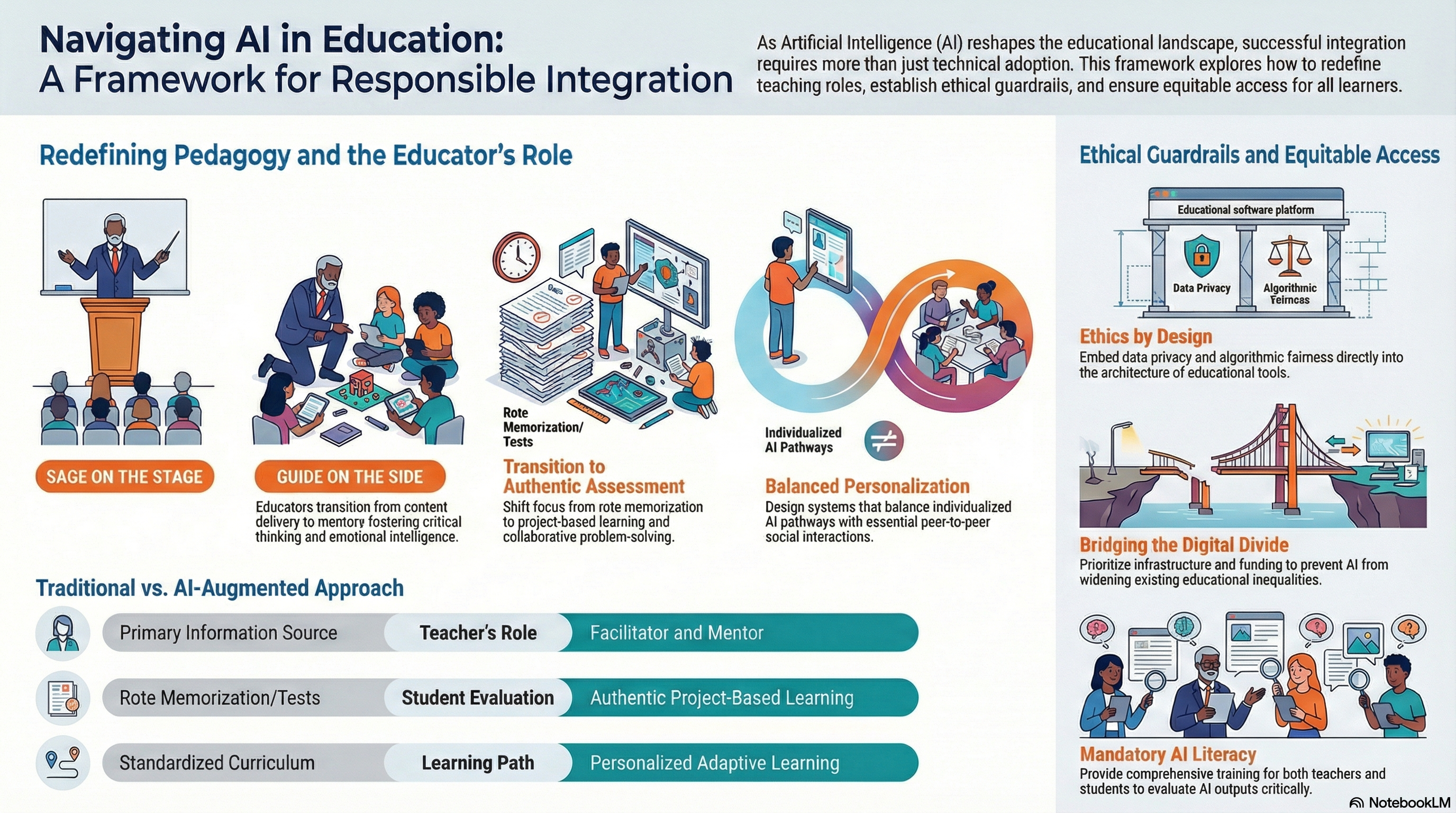
A primary question concerns the evolving role of the teacher. As AI takes over routine tasks such as grading and content delivery, the educator's role is set to shift from a "sage on the stage" to a "guide on the side" (Yadav, 2024). The focus will move towards fostering skills that AI cannot easily replicate: critical thinking, creativity, collaboration, and emotional intelligence. Teachers will become mentors, facilitators of complex problem-solving, and cultivators of a positive and supportive learning environment. This transition requires a significant investment in professional development to equip educators with the skills to manage an AI-augmented classroom and guide students in the ethical use of these new technologies (Abbas, 2023).
Consequently, curricula and assessment methods must also evolve. With generative AI capable of producing essays and solving complex problems (Rane, 2023), assessments based on memorization and standardized tests become less meaningful. The critical question is: How do we assess genuine understanding and skill acquisition in an AI-rich world? The focus must shift towards authentic assessments, such as project-based learning, portfolio development, and collaborative problem-solving, which require students to apply knowledge in novel contexts (Alier, 2024). Educational institutions must develop new policies on academic integrity that acknowledge the existence of AI tools while promoting a culture of honesty and ethical scholarship (Rane, 2024).
Finally, while AI's ability to personalize learning is one of its most impactful benefits (Ayeni, 2024), we must ask: How can AI genuinely personalize learning without creating educational silos? Adaptive learning systems can tailor content to a student's pace and style, potentially improving learning efficacy (Gkintoni, 2025). However, an overemphasis on individualized pathways could diminish opportunities for collaborative learning, peer-to-peer interaction, and exposure to diverse perspectives, all of which are crucial for social and cognitive development. The challenge lies in designing AI systems and pedagogical strategies that balance personalized instruction with the rich, dynamic interactions of a collaborative learning community.
Critical Question 2: What are the Ethical Frameworks Needed for Responsible AI Integration?
The deployment of AI in education is not only a technical or pedagogical issue; it is fundamentally an ethical one (Busch, 2023). As these systems become more embedded in the learning process, a host of ethical considerations arise that require the development of clear guidelines and robust governance frameworks (Mennella, 2024).
A paramount concern is data privacy and security. AI-driven educational platforms collect vast amounts of sensitive student data, from academic performance to behavioral patterns (Eden, 2024). This raises critical questions: Who owns this data? How is it used, stored, and protected from misuse or breaches? (Zhu et al, 2025). Without transparent policies and strong regulatory oversight, there is a significant risk of this data being exploited for commercial purposes or used in ways that could harm students. Establishing an "ethics by design" approach, where privacy considerations are embedded into the architecture of AI systems, is essential (Zhu et al, 2025).
Another major ethical hurdle is mitigating algorithmic bias to ensure fairness. AI systems learn from data, and if that data reflects existing societal biases, the AI will learn and potentially amplify those biases (Ferrara, 2023). In an educational context, this could lead to AI tools that unfairly disadvantage students from marginalized groups, thereby perpetuating and exacerbating educational inequities (Ueda, 2024). The critical question is: How can we develop and deploy AI systems that are fair and equitable for all learners? This requires a commitment to using diverse and representative training data, conducting regular algorithm audits for bias, and ensuring transparency in how AI systems make decisions (Ueda, 2024).
Furthermore, the impact of AI on student well-being and the teacher-student relationship must be carefully considered. Over-reliance on AI could diminish the crucial human interaction and emotional support that are central to education (Zhu et al, 2025). For younger learners, in particular, conversational AI systems that mimic empathy may create an "empathy gap," providing inadequate responses to their emotional needs and potentially hindering their social-emotional development (Kurian, 2023). While AI can be used to assess student emotions (Vistorte, 2024), this capability itself raises further ethical questions about surveillance and emotional privacy. The central challenge is to integrate AI in a way that augments, rather than replaces, the vital human connection in education.
Critical Question 3: How Do We Ensure Equitable and Effective Implementation?
Beyond the pedagogical and ethical dimensions, the practical implementation of AI in education presents significant logistical and equity challenges. Answering these questions is crucial for translating the promise of AI into tangible benefits for all learners.
A primary concern is the potential for AI to exacerbate the existing digital divide. Equitable access to AI technologies is far from guaranteed (Eden, 2024). Disparities in funding, infrastructure, and access to high-speed internet mean that affluent schools and districts are more likely to benefit from advanced AI tools, leaving students in under-resourced communities further behind. This challenge is particularly acute in developing countries, where the gap between AI's potential and its practical implementation is vast due to infrastructure limitations and skill gaps (Aderibigbe, 2023; Chisom, 2024). The critical question for policymakers is: What strategies and investments are needed to ensure that AI in education becomes a tool for equity, not a driver of greater inequality?
Effective implementation also hinges on providing adequate training and support for both educators and students. Simply deploying new technology without preparing its users is a recipe for failure. Teachers require comprehensive professional development to understand not only how to operate AI tools but also how to integrate them meaningfully into their pedagogy (Farooqi, 2024). Similarly, students must be taught AI literacy—the ability to use AI tools effectively, understand their limitations, and critically evaluate their outputs. This calls for an urgent focus on developing ethical AI literacy within teacher training curricula and student learning objectives (Karataş, 2024).
Finally, we must ask how we will measure the success of these complex interventions. It is essential to move beyond anecdotal evidence and develop rigorous methods for evaluating the effectiveness and cost-effectiveness of AI in education (Michie, 2017). Are these tools actually improving learning outcomes, enhancing student engagement, and closing achievement gaps? The significant financial investment required for AI infrastructure, software, and training must be justified by clear, measurable benefits (1961-, 2016). This requires a commitment to ongoing research and evaluation to distinguish between hype and genuine educational value.
Conclusion
The integration of artificial intelligence into education represents a watershed moment, offering unprecedented opportunities to enhance and personalize learning. However, the path forward is not merely a technological one; it is a complex socio-technical journey that demands a deep and ongoing engagement with critical questions of pedagogy, ethics, and equity. The questions outlined in this blog, concerning the role of the educator, the nature of assessment, data privacy, algorithmic fairness, equitable access, and effective implementation, are not meant to be roadblocks but rather essential guideposts for a responsible and thoughtful transition.
Addressing these challenges requires a collaborative effort involving all stakeholders: educators, students, administrators, policymakers, and AI developers (Ueda, 2024). We must move beyond the simplistic view of AI as only a set of tools and instead see it as a catalyst for a broader conversation about the goals and values of education in the 21st century. The ultimate objective is not simply to automate old practices but to transform them. By proactively and critically engaging with these fundamental questions, we can steer the AI revolution in a direction that fulfills its promise, creating a future for education that is not only more technologically advanced but also more human-centered, equitable, and empowering for all learners. The only viable path forward is to embrace this new technology while simultaneously implementing the necessary guardrails to prevent its misuse and ensure its benefits are shared by all (Kamalov, 2023).
References
1961-, N, 1971-, S, B., R, E., S, & G., G (2016). Cost-Effectiveness in Health and Medicine. Oxford University Press eBooks, . https://doi.org/10.1093/acprof:oso/9780190492939.001.0001
Abbas, N, Ali, I, Manzoor, R, Hussain, T, & Hussain, M (2023). Role of Artificial Intelligence Tools in Enhancing Students' Educational Performance at Higher Levels. Journal of Artificial Intelligence Machine Learning and Neural Network, (35), 36-49. https://doi.org/10.55529/jaimlnn.35.36.49
Aderibigbe, A, Ohenhen, P, Nwaobia, N, Gidiagba, J, & Ani, E (2023). ARTIFICIAL INTELLIGENCE IN DEVELOPING COUNTRIES: BRIDGING THE GAP BETWEEN POTENTIAL AND IMPLEMENTATION. Computer Science & IT Research Journal, 4(3), 185-199. https://doi.org/10.51594/csitrj.v4i3.629
Alasadi, E, & Baiz, C (2023). Generative AI in Education and Research: Opportunities, Concerns, and Solutions. Journal of Chemical Education, 100(8), 2965-2971. https://doi.org/10.1021/acs.jchemed.3c00323
Alier, M, García‐Peñalvo, F, & Camba, J (2024). Generative Artificial Intelligence in Education: From Deceptive to Disruptive.. International Journal of Interactive Multimedia and Artificial Intelligence, 8(5), 5-14. https://doi.org/10.9781/ijimai.2024.02.011
Alowais, SA, Alghamdi, SS, Alsuhebany, N, Alqahtani, T, Alshaya, AI, Almohareb, SN, Aldairem, A, Alrashed, M, Bin Saleh, K, Badreldin, HA, Al Yami, MS, Al Harbi, S, & Albekairy, AM (2023). Revolutionizing healthcare: the role of artificial intelligence in clinical practice. BMC medical education, 23(1), 689. https://doi.org/10.1186/s12909-023-04698-z
Ayeni, O, Hamad, N, Chisom, O, Osawaru, B, & Adewusi, O (2024). AI in education: A review of personalized learning and educational technology. GSC Advanced Research and Reviews, 18(2), 261-271. https://doi.org/10.30574/gscarr.2024.18.2.0062
Busch, F, Adams, LC, & Bressem, KK (2023). Biomedical Ethical Aspects Towards the Implementation of Artificial Intelligence in Medical Education. Medical science educator, 33(4), 1007-1012. https://doi.org/10.1007/s40670-023-01815-x
Chan, K, & Zary, N (2019). Applications and Challenges of Implementing Artificial Intelligence in Medical Education: Integrative Review. JMIR Medical Education, 5(1), e13930-e13930. https://doi.org/10.2196/13930
Chisom, O, Unachukwu, C, & Osawaru, B (2024). REVIEW OF AI IN EDUCATION: TRANSFORMING LEARNING ENVIRONMENTS IN AFRICA. International Journal of Applied Research in Social Sciences, 5(10), 637-654. https://doi.org/10.51594/ijarss.v5i10.725
Eden, C, Chisom, O, & Adeniyi, I (2024). Integrating AI in education: Opportunities, challenges, and ethical considerations. Magna Scientia Advanced Research and Reviews, 10(2), 006-013. https://doi.org/10.30574/msarr.2024.10.2.0039
Farooqi, M, Amanat, I, & Awan, S (2024). Ethical Considerations and Challenges in the Integration of Artificial Intelligence in Education: A Systematic Review. Journal of excellence in management sciences., 3(4), 35-50. https://doi.org/10.69565/jems.v3i4.314
Ferrara, E (2023). Fairness and Bias in Artificial Intelligence: A Brief Survey of Sources, Impacts, and Mitigation Strategies. Sci, 6(1), 3-3. https://doi.org/10.3390/sci6010003
Gkintoni, E, Antonopoulou, H, Sortwell, A, & Halkiopoulos, C (2025). Challenging Cognitive Load Theory: The Role of Educational Neuroscience and Artificial Intelligence in Redefining Learning Efficacy. Brain sciences, 15(2). https://doi.org/10.3390/brainsci15020203
Hwang, G, Xie, H, Wah, B, & Gašević, D (2020). Vision, challenges, roles and research issues of Artificial Intelligence in Education. Computers and Education Artificial Intelligence, 1, 100001-100001. https://doi.org/10.1016/j.caeai.2020.100001
Kamalov, F, Calonge, D, & Gurrib, I (2023). New Era of Artificial Intelligence in Education: Towards a Sustainable Multifaceted Revolution. Sustainability, 15(16), 12451-12451. https://doi.org/10.3390/su151612451
Karataş, F, & Yüce, E (2024). AI and the Future of Teaching: Preservice Teachers’ Reflections on the Use of Artificial Intelligence in Open and Distributed Learning. The International Review of Research in Open and Distributed Learning, 25(3), 304-325. https://doi.org/10.19173/irrodl.v25i3.7785
Kurian, N (2023). AI's empathy gap: The risks of conversational Artificial Intelligence for young children's well-being and key ethical considerations for early childhood education and care. Contemporary Issues in Early Childhood, 26(1), 132-139. https://doi.org/10.1177/14639491231206004
Mennella, C, Maniscalco, U, De Pietro, G, & Esposito, M (2024). Ethical and regulatory challenges of AI technologies in healthcare: A narrative review. Heliyon, 10(4), e26297. https://doi.org/10.1016/j.heliyon.2024.e26297
Michie, S, Yardley, L, West, R, Patrick, K, & Greaves, F (2017). Developing and Evaluating Digital Interventions to Promote Behavior Change in Health and Health Care: Recommendations Resulting From an International Workshop. Journal of medical Internet research, 19(6), e232. https://doi.org/10.2196/jmir.7126
Rane, N, Shirke, S, Choudhary, S, & Rane, J (2024). Education Strategies for Promoting Academic Integrity in the Era of Artificial Intelligence and ChatGPT: Ethical Considerations, Challenges, Policies, and Future Directions. Journal of ELT Studies, 1(1). https://doi.org/10.48185/jes.v1i1.1314
Rane, N (2023). Enhancing Mathematical Capabilities through ChatGPT and Similar Generative Artificial Intelligence: Roles and Challenges in Solving Mathematical Problems. SSRN Electronic Journal, . https://doi.org/10.2139/ssrn.4603237
Rashid, A, & Kausik, M (2024). AI revolutionizing industries worldwide: A comprehensive overview of its diverse applications. Hybrid Advances, 7, 100277-100277. https://doi.org/10.1016/j.hybadv.2024.100277
Ueda, D, Kakinuma, T, Fujita, S, Kamagata, K, Fushimi, Y, Ito, R, Matsui, Y, Nozaki, T, Nakaura, T, Fujima, N, Tatsugami, F, Yanagawa, M, Hirata, K, Yamada, A, Tsuboyama, T, Kawamura, M, Fujioka, T, & Naganawa, S (2024). Fairness of artificial intelligence in healthcare: review and recommendations. Japanese journal of radiology, 42(1), 3-15. https://doi.org/10.1007/s11604-023-01474-3
Vistorte, AOR, Deroncele-Acosta, A, Ayala, JLM, Barrasa, A, López-Granero, C, & Martí-González, M (2024). Integrating artificial intelligence to assess emotions in learning environments: a systematic literature review. Frontiers in psychology, 15, 1387089. https://doi.org/10.3389/fpsyg.2024.1387089
Wach, K, Duong, C, Ejdys, J, Kazlauskaitė, R, Korzyński, P, Mazurek, G, Paliszkiewicz, J, & Ziemba, E (2023). The dark side of generative artificial intelligence: A critical analysis of controversies and risks of ChatGPT. Entrepreneurial Business and Economics Review, 11(2), 7-30. https://doi.org/10.15678/eber.2023.110201
Yadav, D, & Yadav, D (2024). NAVIGATING THE LANDSCAPE OF AI INTEGRATION IN EDUCATION: OPPORTUNITIES, CHALLENGES, AND ETHICAL CONSIDERATIONS FOR HARNESSING THE POTENTIAL OF ARTIFICIAL INTELLIGENCE (AI) FOR TEACHING AND LEARNING. BSSS Journal of Computer, 15(1), 38-48. https://doi.org/10.51767/jc1503
Zhu, H., Sun, Y., & Yang, J. (2025). Towards responsible artificial intelligence in education: a systematic review on identifying and mitigating ethical risks. Humanities and Social Sciences Communications, 12, 1111. https://doi.org/10.1057/s41599-025-05252-6